on sale
Manufacturer
Hocoma (Switzerland, 1999): a leader in rehabilitation robotics. Lokomat: 1,000th unit in 2020, 260+ facilities.
Swiss company Hocoma, founded in 1999 by Gery Colombo, Matthias Jörg and Peter Hostettler, is a global leader in rehabilitation robotics built around motion sensors. Its position is comparable to Ekso Bionics or ReWalk Robotics in the rehab segment, although Hocoma focuses on stationary equipment for clinics rather than wearable exoskeletons for walking outside a care facility.
Its flagship Lokomat is used for gait training, and by 2020 the 1,000th unit had been installed, across more than 260 facilities worldwide, a scale rarely seen among the manufacturers profiled here.
The portfolio is rounded out by Armeo (upper-limb rehabilitation, in Power, Spring, SpringPro and Senso variants), Erigo (early patient mobilization), Andago (a mobile robot for gait training) and Valedo (back-pain therapy). The model covered here is the LokomatPro together with its Sensation variant, currently on sale.
The exact location of the headquarters (in the Zurich area) has not been independently and unambiguously confirmed. Presence in Poland is not directly confirmed, although rehabilitation equipment of this class does reach large neurorehabilitation centers.
Hocoma is a Swiss company founded in 1999 by Gery Colombo, Matthias Jörg and Peter Hostettler. From the start it focused on rehabilitation robotics, meaning equipment that helps patients regain function in a clinic after injuries and strokes. The company is regarded as a global leader in rehabilitation based on motion sensors. Its flagship product, Lokomat, is used for gait training. By 2020 the thousandth unit had been installed, and the device works in more than 260 facilities worldwide, a scale rarely seen among the manufacturers we cover. Over time the portfolio grew to include devices for the upper limb, early mobilisation and back-pain therapy. Beyond the founding date and the founders, details of the company’s history are thin in the available material. We likewise have no reliable data on funding, valuation or headcount. This is the profile of a medical-technology firm that grows steadily and relies on clinical results rather than loud announcements.
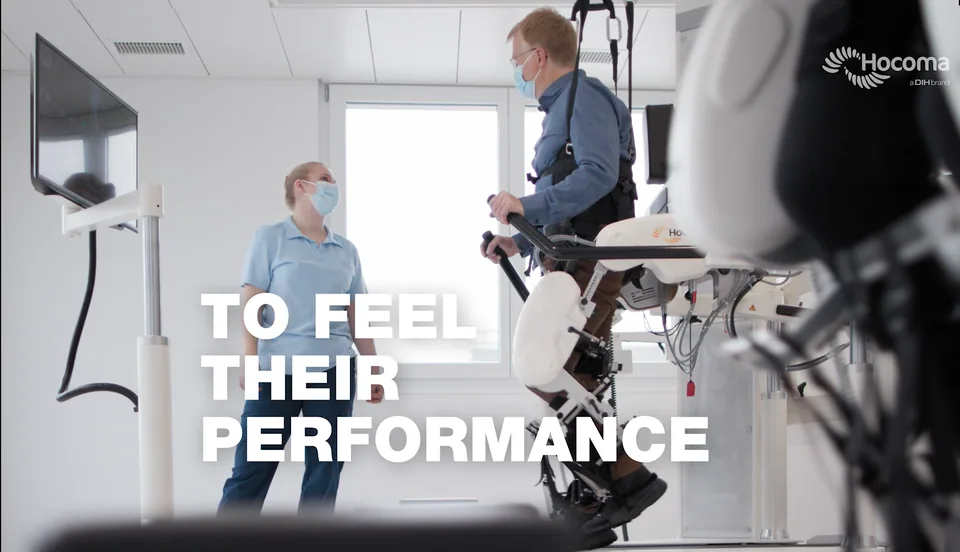
The core of the offer is LokomatPro, the LokomatPro with its Sensation variant, which is on sale. It is a stationary system for robotic gait training, also available in a paediatric version, intended for clinics and rehabilitation centres. The manufacturer cites more than a thousand installations and about 70 clinical studies, but does not publish a price. In the exoskeletons category it is a special case, because the patient does not leave the facility with it — they walk on a treadmill under a therapist’s supervision. Besides Lokomat, Hocoma offers Armeo for upper-limb rehabilitation in the Power, Spring, SpringPro and Senso variants, Erigo for early mobilisation of patients, Andago, a mobile robot for gait training, and Valedo for back-pain therapy. Only LokomatPro is described in our catalog, so for the other devices we rely solely on the manufacturer’s description. The difference between clinical equipment and exoskeletons for work or everyday use is explained in “Exoskeletons in Rehabilitation and Industry”. All of these devices are designed for work in medical facilities under a qualified therapist, not for independent use at a patient’s home, which sets them apart from models such as the EksoNR or the ReWalk Personal.
In robotic rehabilitation Hocoma is the best-known name, but it plays a different game from makers of wearable exoskeletons. It is often compared with Ekso Bionics and Lifeward, yet those companies develop devices a patient can also put on outside a clinic, whereas Hocoma concentrates on stationary equipment in clinics. Cyberdyne and its HAL system represent yet another approach, based on signals from the user’s muscles. What speaks most for Hocoma’s standing is the installed base: more than a thousand Lokomats in over 260 facilities is a result hard to match with the available data on competitors. We do not, however, have market shares, revenues or a price comparison, so we do not claim the firm holds the largest share of the segment. We only know that in the niche of robotic gait training it is among the best documented. The value of such a position lies in credibility: medical facilities choose suppliers whose equipment has a documented track record.
Hocoma’s direct presence in Poland is not confirmed. We do not know of a Polish distributor or a list of facilities working with Lokomat. Equipment of this class usually goes to large neurorehabilitation centres and clinical hospitals, but our material contains no specific deployments in Poland that we could name here. For a facility considering a purchase, the first step is therefore to ask the manufacturer directly for an authorised representative and a quote, since no public price is available. The wider context of robots in Polish hospitals is covered in the hospital section.
Hocoma is the best-documented maker of gait-training robots for clinics, with a thousand installations and dozens of studies behind it. It is an offer for medical facilities, not private individuals, and has no public price. If you run a rehabilitation ward, it is worth starting a conversation with the manufacturer. The price is not disclosed, so the cost has to be established in a sales conversation, and the decision is best based on clinical studies and references from other centres. For private individuals seeking a home exoskeleton, wearable solutions are a better starting point.
Hocoma AG