Compare
Dobot MG400 vs myCobot 280 M5Stack: Two Budget Arms for Learning and Light Tasks
Key facts
- Price in PolandDobot MG400: approx. 24,700 PLN* (≈ EUR 5,650 at NBP rate 4.3716 of 20 October 2026) · myCobot 280: 3,990 PLN (≈ EUR 915)
- PayloadDobot MG400: 0.75 kg · myCobot 280: 0.25 kg
- StatusDobot MG400: on sale · myCobot 280: on sale
- In PolandDobot MG400: yes · myCobot 280: yes
A technical school, a robotics club, a university lab, a tinkerer with a budget for a single arm — these are the people who compare the Dobot MG400 with the myCobot 280. Both devices fit on a desk and cost incomparably less than a classic industrial cobot, but they represent two different ideas for learning robotics. The Chinese Dobot targets educational stations and light desktop automation, while Elephant Robotics, founded in 2016, aims at programming courses and hobbyists. The question asked most often is whether more axes mean more capability. Here the answer runs against expectation, because the arm with fewer axes lifts three times as much.
| Feature | Dobot MG400 | myCobot 280 |
|---|---|---|
| Manufacturer | Dobot (Shenzhen Yuejiang Technology) | Elephant Robotics |
| Price (PLN) | approx. 24,700 PLN* (≈ EUR 5,650)(converted from 5,649 EUR, NBP rate 4.3770, as of 1 October 2026) | 3,990 PLN (≈ EUR 915) |
| Degrees of freedom | 4 | 6 |
| Payload (kg) | 0.75 | 0.25 |
| Status | on sale | on sale |
Design and specifications
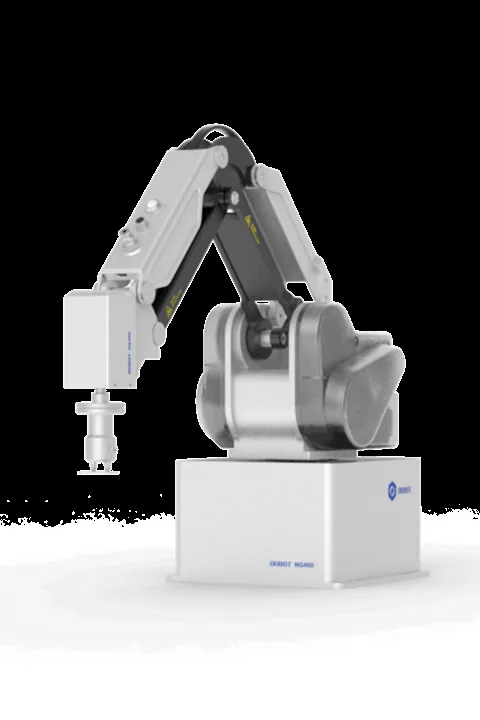
The MG400 has four degrees of freedom and is a SCARA-type arm with a base of just 190 × 190 mm and a reach of 440 mm. Its payload is 0.75 kg. The myCobot 280 has six degrees of freedom but a payload of only 0.25 kg, one third as much; the maker advertises it as the smallest six-axis arm in the world. Six axes give full freedom to orient the gripper in space; four give movement horizontally and vertically with rotation about one axis, which suffices for moving parts from one plane to another (see “Degrees of Freedom (DOF) in Humanoid Robots”). More axes do not mean more strength here, but more freedom of movement on lighter tasks.
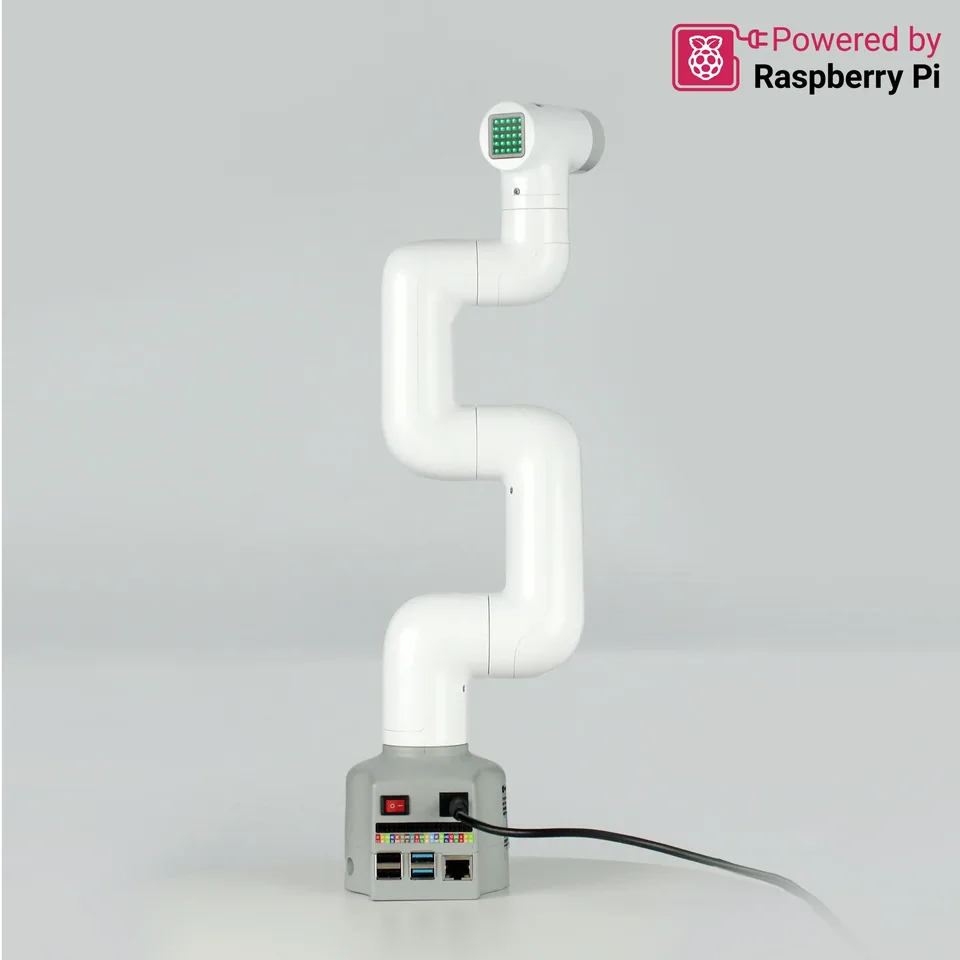
The second difference is the electronics. The myCobot 280 runs on an M5Stack module based on an ESP32 processor and supports programming in Python, C++, Arduino, C# and JavaScript, which makes it an open hobbyist platform. The MG400 is closer to light industry: it comes as a starter kit with a vacuum gripper and a one-year warranty. With a 250 g payload, production use is practically ruled out — this is demonstration and learning equipment; the weight of the gripper eats a large share of the load budget, worth remembering when reading “How to Read a Robot Datasheet”. The higher educational tier in these makers' ranges is occupied by the Dobot Magician and the myCobot 320; an industrial cobot such as the UR3e is an entirely different order of cost, as “What Is a Cobot and How Does It Differ from an Industrial Robot” explains.
Price and availability in Poland
Price is the main difference. The myCobot 280 costs „only 599 USD” according to the manufacturer's page, which at the National Bank of Poland rate from the 1 October 2026 (3.8762 zloty to the dollar) is about 2,322 zloty. The seller does not convert this to zloty, so the real cost in Poland, with shipping and possible duty, will be higher. The MG400 is dearer and spread across markets: the US reseller RobotLAB offers a starter kit for 2,890 USD, a European distributor gives 5,649 EUR, or about 24,700 zloty. On Poland's Allegro an offer for the arm at 12,565 zloty was recorded.
Availability varies. Elephant Robotics names no official Polish distributor; the arm is available from European electronics retailers. Polish shops such as Botland carry M5Stack products, but whether they have this particular arm must be checked. Dobot has more points in Poland: the brand is in the range of Dobot Polska, GM Automatyka, Edutech Expert and Botland.store, though not every one of them need stock the MG400.
Which model for which job
In a school and at a university both arms will serve as programming-learning equipment, but each differently. The myCobot 280 is a cheaper entry for classes in Python, ROS and microcontrollers; several arms for a group cost about as much as one MG400. The MG400 better reflects an industrial workstation — repeatable pick and place, a gripper set, a base to bolt to the table — so it helps where students should see what small cell automation looks like.
In a laboratory and a project workshop, the MG400 will be better for experiments with arranging light parts, the myCobot for prototyping interfaces and control, for instance with a camera or artificial intelligence. Neither should be mistaken for a production cobot: at 250 or 750 g of payload these are educational models, and how to begin is covered in “How to Start Learning Robotics in Poland”. A full overview of the category is in educational robots, and equipment selection for institutions is discussed in “Educational Robots for Schools and Universities”. If you are interested in cheap arms in a more mechatronic form, take a look at the range of igus, which includes inexpensive ReBeL arms.
Conclusion
The MG400 has four axes and a 0.75 kg payload; the myCobot 280 has six axes but a lower payload of 0.25 kg. That is the reverse of the usual pattern: here, more axes do not mean more strength, only more freedom of movement for lighter tasks. Price is the key difference. The myCobot 280 starts at USD 599 according to the manufacturer, while the MG400 starts at around USD 2,890 from the reseller RobotLAB, although a European distributor lists a higher price of EUR 5,649 (about PLN 24,726). The gap suggests the price depends on the market and configuration. The myCobot 280 runs on its own M5Stack module built around an ESP32, which makes it a more open hobbyist platform, while the MG400 sits closer to light industry, with a starter kit and a one-year warranty. For pure education and Python experiments, the myCobot 280 is the cheaper way in; for light pick-and-place work closer to real industrial conditions, the MG400 has the advantage.
For pure education, Python courses and experiments on a small sum — the myCobot 280. It is clearly cheaper, has six axes and an open M5Stack platform. For light pick-and-place tasks meant to resemble industrial conditions, and for a team that needs a higher payload and a kit with a warranty — the Dobot MG400.
Frequently asked questions
Which model is cheaper?
The myCobot 280, from USD 599, clearly cheaper than the MG400, which starts at around USD 2,890.
How many axes does each robot have?
The MG400 has four axes and the myCobot 280 has six, despite its lower payload.
What does the myCobot 280 run on?
An M5Stack module built around the ESP32 microcontroller, which makes it an open platform for hobbyists and education.
Is either suitable for production?
Not as a production robot. The MG400 is closer to light desktop automation, while the myCobot 280 is demonstration and educational equipment.
Sources
- Dobot MG400 · dobot.nu
- Dobot MG400 · robotlab.com
- Dobot MG400 · govolition.com
- myCobot 280 · elephantrobotics.com
- myCobot 280 · shop.elephantrobotics.com
- myCobot 280 · the-gadgeteer.com