Key findings
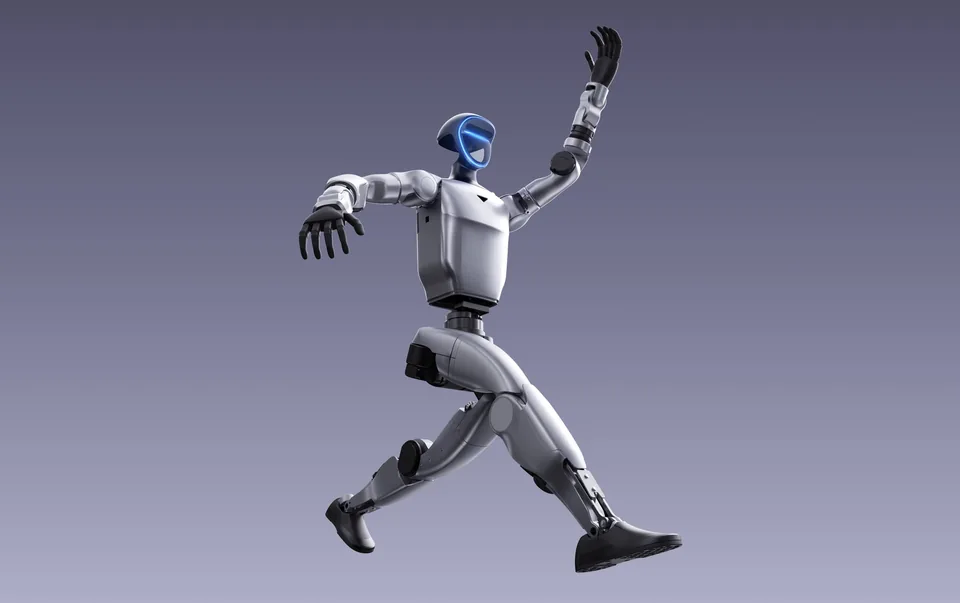
- Among the humanoids the Unitree H2 has the highest torque limit: 360 Nm at the hip and knee; the R1 has 60 Nm.
- Among the quadrupeds the B2 and B2-W are strongest (320 Nm) and the Go2-W weakest (35.55 Nm).
- The wheeled versions (B2-W, Go2-W) have 16 movable joints instead of 12.
- The model mass differs from the maker's spec-sheet weight — for the H1, 59.3 kg against 47 kg.
Key facts
- Samplen = 13
- Data as of14 October 2026
- Tables1 · charts: 1
- Number of sources13
In this article
Unitree publishes simulation models of its robots on GitHub (URDF and MJCF files, BSD-3 licence). They record, among other things, the torque limit of every joint, the number of movable joints and the masses of the individual links. We read these values by machine for 13 robots in our catalogue, and an independent check of 150 random values found no errors. These are not spec-sheet figures — they are the parameters the maker ships for simulation and control training.
Humanoids: from 60 to 360 Nm
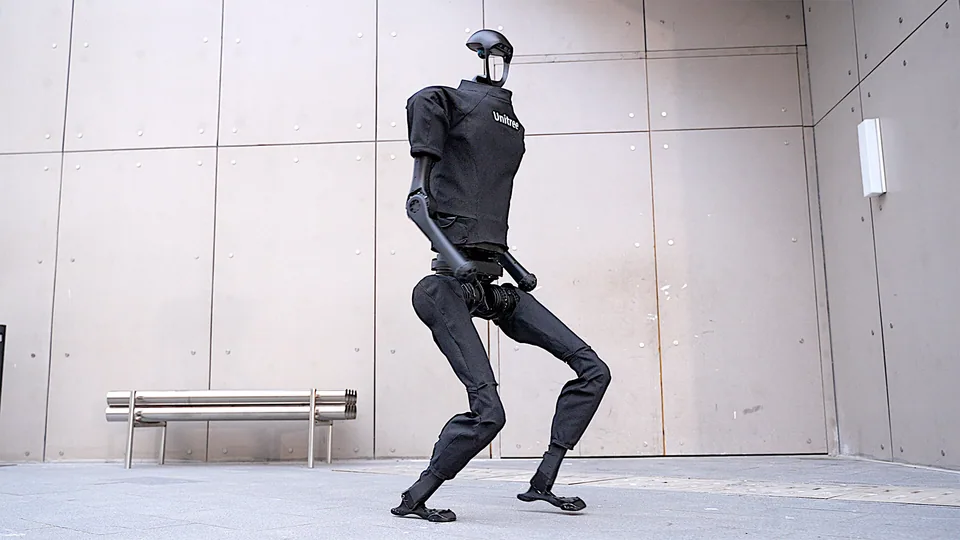
The highest torque limit belongs to the Unitree H2: 360 Nm at the hip and knee. The Unitree H1 and H1-2 have 300 Nm at the knee, the Unitree G1 139 Nm at the hip and knee, and the Unitree R1 and R1 Air 60 Nm each. That is a sixfold difference between the R1 and the H2 — a clear sign that the R1 is an education platform while the H2 and H1 are full-size robots. For the G1 the maker's spec sheet gives a maximum knee torque of 90 Nm; the 139 Nm in the model is the limit set for simulation, not a promise for the real robot.
Quadrupeds: from 35.55 to 320 Nm
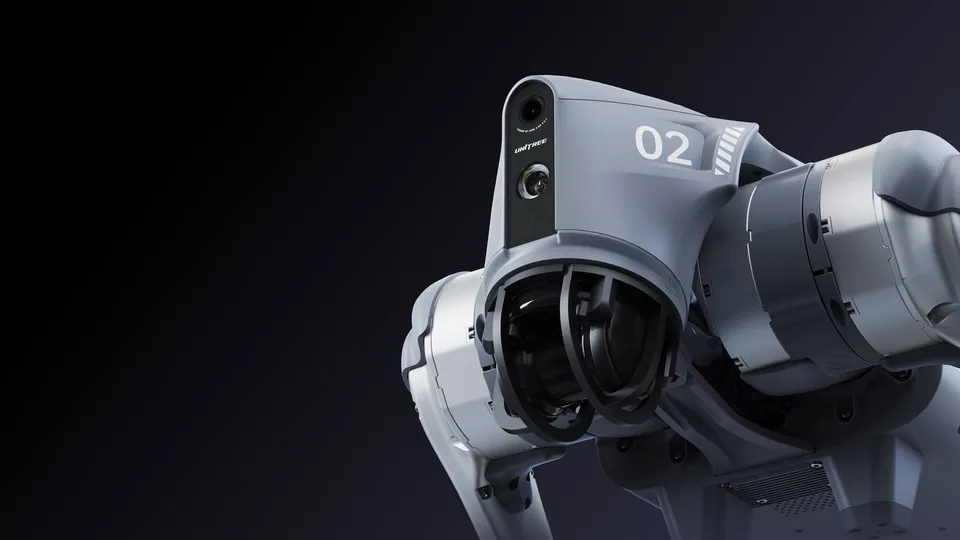
Among the quadrupeds the strongest are the Unitree B2 and B2-W (320 Nm at the calf each), followed by the Unitree A2 (180 Nm), the As2 (90 Nm), the Unitree Go2 (45.43 Nm) and the Go2-W (35.55 Nm). The wheeled versions have four joints per leg instead of three — which is why the B2-W and Go2-W count 16 movable joints, not 12.
Torque per kilogram
Dividing the highest torque by the model mass puts the As2 (5.11 Nm/kg) and the H1 (5.06 Nm/kg) on top and the R1 (2.08 Nm/kg) and the Go2-W (1.82 Nm/kg) at the bottom. It is a simplified indicator — it describes only the strongest joint, not the whole robot.
Model mass is not the robot's weight
The model mass is the sum of the link masses stored in the file. For the H1 it comes to 59.3 kg while the maker states 47 kg; for the B2 74.6 kg against 60 kg. A model can contain parts that the basic version lacks, or leave out the battery and covers — so the catalogue keeps the maker's spec-sheet weight and shows the model mass separately.
Charts
Chart data table
| Category | Torque (Nm) |
|---|---|
| Unitree H2 | 360 |
| Unitree H1 | 300 |
| Unitree H1-2 | 300 |
| Unitree G1 (23 DoF) | 139 |
| Unitree G1 EDU (43 DoF, with hands) | 139 |
| Unitree R1 | 60 |
| Unitree R1 Air | 60 |
| Unitree B2 | 320 |
| Unitree B2-W | 320 |
| Unitree A2 | 180 |
| Unitree As2 | 90 |
| Unitree Go2 | 45.4 |
| Unitree Go2-W | 35.5 |
Data tables
Joints, torques and masses in Unitree's simulation models
| Model | Type | Movable joints | Degrees of freedom per limb | Max. torque (Nm) | Joints with max. torque | Model mass (kg) | Maker's weight (kg) | Torque per kg of model mass (Nm/kg) |
|---|---|---|---|---|---|---|---|---|
| Unitree H2 | humanoid | 31 | legs 2×6, arms 2×7, torso 3, head 2 | 360 | hip, knee | 75.6 | 70 | 4.76 |
| Unitree H1 | humanoid | 19 | legs 2×5, arms 2×4, torso 1 | 300 | knee | 59.3 | 47 | 5.06 |
| Unitree H1-2 | humanoid | 27 | legs 2×6, arms 2×7, torso 1 | 300 | knee | 67 | 70 | 4.48 |
| Unitree G1 (23 DoF) | humanoid | 23 | legs 2×6, arms 2×5, torso 1 | 139 | hip, knee | 32.1 | 35 | 4.33 |
| Unitree G1 EDU (43 DoF, with hands) | humanoid | 43 | legs 2×6, arms 2×7, hands 2×7, torso 3 | 139 | hip, knee | 34.4 | 35 | 4.04 |
| Unitree R1 | humanoid | 26 | legs 2×6, arms 2×5, torso 2, head 2 | 60 | hip, knee, waist, shoulder | 28.8 | 29 | 2.08 |
| Unitree R1 Air | humanoid | 20 | legs 2×6, arms 2×4 | 60 | hip, knee, shoulder | 26.7 | 25 | 2.25 |
| Unitree B2 | quadruped | 12 | front legs 2×3, rear legs 2×3 | 320 | calf | 74.6 | 60 | 4.29 |
| Unitree B2-W | quadruped | 16 | front legs 2×4, rear legs 2×4 | 320 | calf | 82.4 | 80 | 3.88 |
| Unitree A2 | quadruped | 12 | front legs 2×3, rear legs 2×3 | 180 | calf | 40.1 | 42 | 4.49 |
| Unitree As2 | quadruped | 12 | front legs 2×3, rear legs 2×3 | 90 | calf | 17.6 | 20 | 5.11 |
| Unitree Go2 | quadruped | 12 | front legs 2×3, rear legs 2×3 | 45.43 | calf | 16.1 | 15 | 2.82 |
| Unitree Go2-W | quadruped | 16 | front legs 2×4, rear legs 2×4 | 35.55 | calf | 19.5 | 18 | 1.82 |
Method
Values read by machine (XML parser, no language models) from URDF files in the unitreerobotics/unitree_ros repository (commit 5994d4f, BSD-3 licence), one file per robot. Movable joints = revolute and prismatic joints; max. torque = highest "effort" value in the file; mass = sum of link masses. Independent check: 150 random values from 50 files, 0 errors. The maker's weight comes from the spec sheets in our database.
Limits of the data
These are simulation parameters, not spec-sheet figures or measurements. A torque limit in the model is not the continuous or peak torque of the real robot. For robots that come in several versions we chose one file (e.g. the G1 with 23 or 43 degrees of freedom). Joint angle ranges are left out.
Frequently asked questions
Where do these values come from?
From the simulation models Unitree publishes on GitHub under the BSD-3 licence (unitree_ros repository). We read them by machine and checked 150 random values independently — with no errors.
Is 139 Nm the real knee torque of the Unitree G1?
No. It is the limit set in the simulation model. The maker's spec sheet gives the G1 a maximum knee torque of 90 Nm.
Which Unitree robot has the strongest joints?
In the simulation models: the H2 among humanoids (360 Nm) and the B2 and B2-W among quadrupeds (320 Nm each).
Why does the B2-W have 16 joints and the B2 12?
The wheeled version adds a wheel drive to every leg, so each leg has four joints instead of three.
Sources
- github.com/unitreerobotics/unitree_ros/blob/5994d4faef0a9cadd3287f8de0199a67e…
- github.com/unitreerobotics/unitree_ros/blob/5994d4faef0a9cadd3287f8de0199a67e…
- github.com/unitreerobotics/unitree_ros/blob/5994d4faef0a9cadd3287f8de0199a67e…
- github.com/unitreerobotics/unitree_ros/blob/5994d4faef0a9cadd3287f8de0199a67e…
- github.com/unitreerobotics/unitree_ros/blob/5994d4faef0a9cadd3287f8de0199a67e…
- github.com/unitreerobotics/unitree_ros/blob/5994d4faef0a9cadd3287f8de0199a67e…
- github.com/unitreerobotics/unitree_ros/blob/5994d4faef0a9cadd3287f8de0199a67e…
- github.com/unitreerobotics/unitree_ros/blob/5994d4faef0a9cadd3287f8de0199a67e…
- github.com/unitreerobotics/unitree_ros/blob/5994d4faef0a9cadd3287f8de0199a67e…
- github.com/unitreerobotics/unitree_ros/blob/5994d4faef0a9cadd3287f8de0199a67e…
- github.com/unitreerobotics/unitree_ros/blob/5994d4faef0a9cadd3287f8de0199a67e…
- github.com/unitreerobotics/unitree_ros/blob/5994d4faef0a9cadd3287f8de0199a67e…
- github.com/unitreerobotics/unitree_ros/blob/5994d4faef0a9cadd3287f8de0199a67e…
How to cite
When citing this analysis, give the title, the page address and the date of the last update. Suggested form:
Robolupa editorial team, "Unitree Joint Torques and Degrees of Freedom in the Simulation Models", Robolupa (robolupa.com), published 14 October 2026, updated 14 October 2026, https://robolupa.com/analysis/unitree-joint-torques/.
Download the data (CSV)
Tables as CSV: UTF-8, comma separated, unformatted values. When you reuse them, please credit Robolupa, the address of this page and the date of the last update. Data: CC BY 4.0, cite: Robolupa.
About the authors
A chief engineer by profession (technical head of a ship's machinery plant, licensed). Sets the site's editorial rules and is responsible for them; he does not read every page before publication.
Texts are prepared by the editorial team using AI tools. We compare data with primary sources on a sample basis, not page by page. Our rules are described here: How we check · About us