FANUC Corporation
Compare
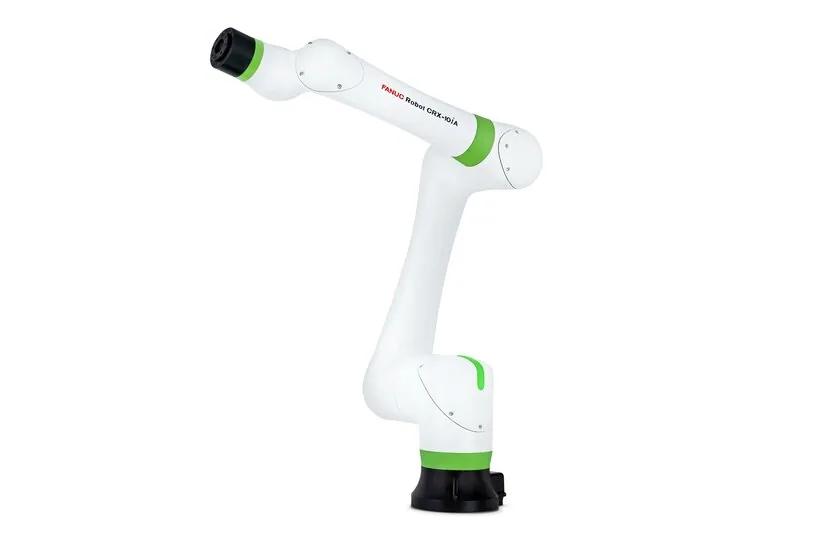
An integrator choosing a cobot for machine tending or assembly very often ends up with two names on the shortlist: the FANUC CRX-10iA and the UR12e. The first is a model from Japan’s FANUC, introduced in 2019, that opened the CRX family. The second is a newcomer from Denmark’s Universal Robots, launched in May 2025 as the successor to the UR10e. The question comes both from firms that already have FANUC machine tools and controllers on the floor and from plants starting automation from scratch. Both arms have six axes and a payload around 10 kg, so the choice comes down to details: reach, how contact is detected, the software ecosystem and whether there is a supplier in Poland. If this is your first cobot, read “How to Buy a Cobot Step by Step” first, and for the difference between a cobot and a classic robot see “Cobot or Industrial Robot”.
FANUC Corporation
Universal Robots A/S
| Feature | FANUC CRX-10iA | UR12e |
|---|---|---|
| Manufacturer | FANUC Corporation | Universal Robots A/S |
| Price (PLN) | no data | no data |
| Degrees of freedom | 6 | 6 |
| Payload (kg) | 10.0 | 12.5 |
| Status | on sale | on sale |
The CRX-10iA has six axes, an electric drive, a 10 kg payload and a reach of 1,249 mm according to FANUC’s materials. Contact force is detected internally, on all axes, so the arm reacts to a collision without extra skin sensors. The UR12e also has six axes and an electric drive, but a 12.5 kg payload and a 1,300 mm reach. According to the manufacturer, 12.5 kg is the real capacity, not a rounded figure from the old e-Series naming. The force/torque sensor sits at the tool flange rather than in every joint.
In practice these are two different philosophies. FANUC, according to the manufacturer, spreads force sensing across the whole kinematic chain of the arm. UR measures force where the tool works, which is convenient for tasks that need controlled pressing, such as sanding or press-fitting parts. The UR12e offers 2.5 kg more payload and 51 mm more reach. Keep in mind that in both cases the gripper’s mass reduces the usable payload, and you need to read from the datasheet how the manufacturer counts it; the article “How to Read a Robot Datasheet” helps with that.
Neither FANUC nor Universal Robots publishes an explicit price for either model. The final cost depends on the gripper, the controls, the guarding and the integrator’s work, which can be as significant an item as the arm itself. It makes sense, therefore, to request quotes for an identical work cell.
In Poland the CRX-10iA is listed with spawalnictwo.pl as its distributor, but availability of a specific version has to be confirmed by enquiry. Universal Robots keeps a public distributor page at universal-robots.com/pl, and Elmark Automatyka carries UR collaborative robots in its range. The CP Trade page describes only the older UR3, UR5 and UR10, so do not treat it as confirmation that the new UR12e is available. When buying, also check service support in your region and the delivery time.
Both models go into similar jobs. FANUC names machine tending and assembly, and UR adds palletizing. In a factory, the CRX-10iA is the natural choice where the machine park is already FANUC: the same controller, the same service, similar programming logic. The UR12e wins when you want a broad library of ready accessories, grippers and third-party applications, because the UR ecosystem is the largest in the industry.
A 1,300 mm reach and 12.5 kg payload give the UR12e an edge when loading larger pallets or stations with several feeders. In a warehouse, for light palletizing and packing, that matters. For grippers and accessories, consider suppliers such as Robotiq or OnRobot, which serve both arms. We cover the FANUC family in more detail in “FANUC CRX: The Cobot Series with 8 Years of Zero Maintenance”.
The CRX-10iA has been on the market since 2019 and holds an established position in assembly and machine tending, with a 10 kg payload and six axes equipped with internal force sensing. The UR12e, launched in May 2025, offers a slightly larger payload of 12.5 kg as part of Universal Robots' new e-Series generation, with a force-torque sensor at the tool flange. Both are commercially available in Poland: the CRX-10iA through spawalnictwo.pl, the UR12e through elmark.com.pl, which makes the comparison practical for local integrators. The design difference lies in where the sensors sit: FANUC builds them into every axis, while the UR12e relies on a single sensor at the tool flange. Neither manufacturer publishes a price openly. For companies already invested in the FANUC ecosystem the CRX-10iA is the natural continuation; for new deployments with a larger payload, the UR12e has the newer programming platform.
For a plant that already runs FANUC machines and robots, the CRX-10iA is a sensible continuation: familiar service, a familiar controller, force sensing across the whole arm. For an integrator who builds many different cells and needs the largest accessory library and a newer platform, the UR12e is the better pick, the more so as it offers slightly more payload and reach. If your parts approach 12 kg or the workstation is spread out, choose the UR12e. If contact detection along the entire arm and support for an existing FANUC fleet matter most, choose the CRX-10iA. To narrow the decision, ask both distributors for a quote and check that the robot fits your space using the dimensions in the datasheets. A same-class alternative is the Doosan M1013.
The UR12e, at 12.5 kg, slightly ahead of the CRX-10iA, which carries 10 kg.
Yes: the CRX-10iA through spawalnictwo.pl, and the UR12e through elmark.com.pl.
FANUC integrates force sensors in all six axes, while the UR12e has a single force-torque sensor at the tool flange.
The UR12e, with a payload of 12.5 kg. The CRX-10iA carries 10 kg.
The UR12e, with 1,300 mm against 1,249 mm for the CRX-10iA.
FANUC detects contact internally on all axes. The UR12e has a single force/torque sensor at the tool flange.
No. Neither manufacturer publishes a price list, and the price depends on configuration and integration.