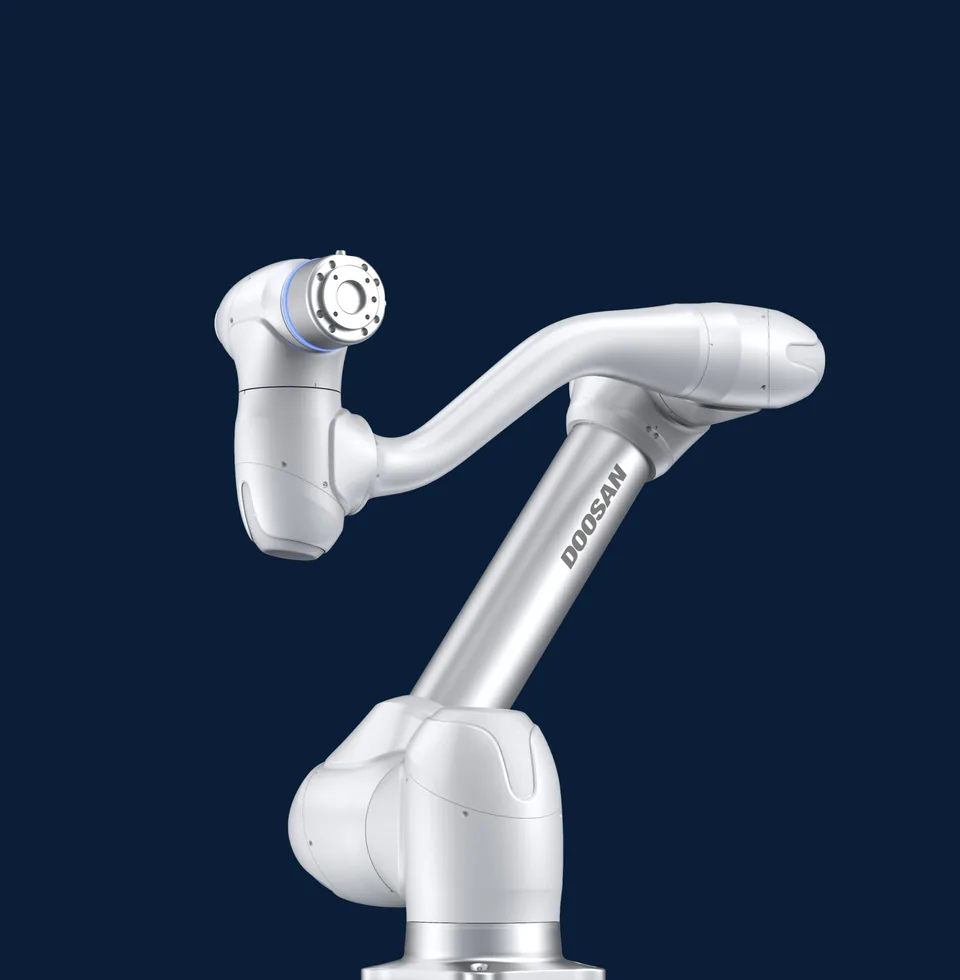
Doosan Robotics Inc.
Compare
A comparison of the Doosan M1013 and the UR12e. The first robot comes from Korea’s Doosan Robotics and according to the manufacturer is the best-selling model of the M series. The second is a newcomer from Denmark’s Universal Robots from May 2025, the successor to the UR10e, from a brand with the largest ecosystem in the industry. The numbers are close, so the question is rather who you want to work with: a global standard or a specialised integrator. Before deciding, read “How to Buy a Cobot Step by Step”; we also describe Doosan in “Doosan Robotics: Cobots from the Korean Maker in Poland”.
Doosan Robotics Inc.
Universal Robots A/S
| Feature | Doosan M1013 | UR12e |
|---|---|---|
| Manufacturer | Doosan Robotics Inc. | Universal Robots A/S |
| Price (PLN) | no data | no data |
| Degrees of freedom | 6 | 6 |
| Payload (kg) | 10.0 | 12.5 |
| Status | on sale | on sale |
The M1013 has six axes, a 10 kg payload and a 1,300 mm reach. There is a torque sensor in every joint. The UR12e has six axes, a 12.5 kg payload and the same 1,300 mm reach, with a force/torque sensor at the tool flange only. The UR manufacturer stresses that 12.5 kg is the real, not a rounded, capacity.
The reach is therefore identical, and the payload differs by 2.5 kg in the UR12e’s favour. The fundamental design difference concerns sensing: Doosan places torque sensors throughout the arm, UR measures force at the tool. The first approach lets contact be detected on every link, the second works well in tasks with controlled pressing. We state the weight of neither robot because it is not in the sources. Nor do we have verified speed data, so we do not rule on which is faster. The method for reading such comparisons is described in “How to Read a Robot Datasheet”. In practice you only see the payload difference after subtracting the gripper’s mass: with a 2 kg gripper per part, 8 kg remains on the M1013 and 10.5 kg on the UR12e, provided both manufacturers count payload without tooling, which has to be confirmed in the datasheet.
Neither manufacturer gives an explicit price. For Doosan the price is set individually by the distributor, and for the UR12e the cost information comes from distributors. We therefore cannot say which is cheaper, and we encourage comparing quotes for a complete cell with gripper and integration.
In Poland, according to the trade press, Doosan Robotics is represented by Transition Technologies-CS as distributor, and the model is sold through a specialised integrator; sales sites need confirming. The UR12e is carried by Elmark Automatyka (Universal Robots collaborative robots). The CP Trade page describes only the older UR3, UR5 and UR10, so availability of the UR12e there needs confirming. Ask each about delivery time, service and operator training, and about what is included in the price: controller, programming pendant, software, initial training and warranty.
The M1013 is promoted as a solution for standard machine tending and assembly, with no standout special features. That is a weakness and a strength at once: it seeks no niche but is enough for many tasks in a factory. Torque sensors in the joints suit cells where a person works close to the robot. A relationship with a local integrator can be more practical than with a general supplier.
The UR12e has the ecosystem advantage: the largest library of grippers, cameras and palletizing applications, for example from OnRobot or Robotiq, and the most integrators. In a warehouse, for palletizing medium loads, that is a real time saving. If you are considering another arm in the 10–12 kg class, check the FANUC CRX-10iA and the Techman TM12.
The M1013 and UR12e have similar payloads, 10 kg against 12.5 kg, and the same six axes, with torque sensors in every joint on the M1013 against a single sensor at the tool flange on the UR12e. The M1013 belongs to Doosan's broad family, ranging from light to heavy models, which is sold in Poland by a specialist integrator, coboty-doosan.pl (Transition Technologies-CS), while the UR12e comes through general automation distributors, elmark.com.pl. Neither manufacturer discloses an openly listed price. Doosan promotes the M1013 as a solution for standard machine tending and assembly without any standout special features; the UR12e benefits from the brand of the cobot market leader, with the largest ecosystem of third-party software. For companies that value a wide choice of ready-made applications and community support, the UR12e has the ecosystem advantage; for a relationship with a local integrator, the M1013 may be the more practical option.
For firms that value a broad choice of ready applications, community support and the newest platform, and want a higher payload, the UR12e will be the better pick. For firms that prefer a close relationship with a single specialised integrator and want torque sensors in every joint, the M1013 is a sensible alternative. The reach is the same, so do not base the decision on it. For a first deployment we advise choosing the supplier who will best support you after the purchase, because prices on both sides are unknown and hard to compare. Ask both teams for a quote on an identical cell and only then decide.
The UR12e, at 12.5 kg, slightly more than the 10 kg stated for the M1013.
Through the specialist integrator coboty-doosan.pl (Transition Technologies-CS).
Yes, unlike the UR12e, which has a single force-torque sensor only at the tool flange.
The UR12e, at 12.5 kg. The M1013 carries 10 kg. The reach of both is 1,300 mm.
Doosan Robotics is represented in Poland by Transition Technologies-CS as distributor. Availability has to be confirmed by enquiry.
Yes, it has torque sensors in the joints. The UR12e has a single force/torque sensor at the tool flange.
No. Neither manufacturer publishes a price, so it is not known which is cheaper.