ANYbotics AG
Compare
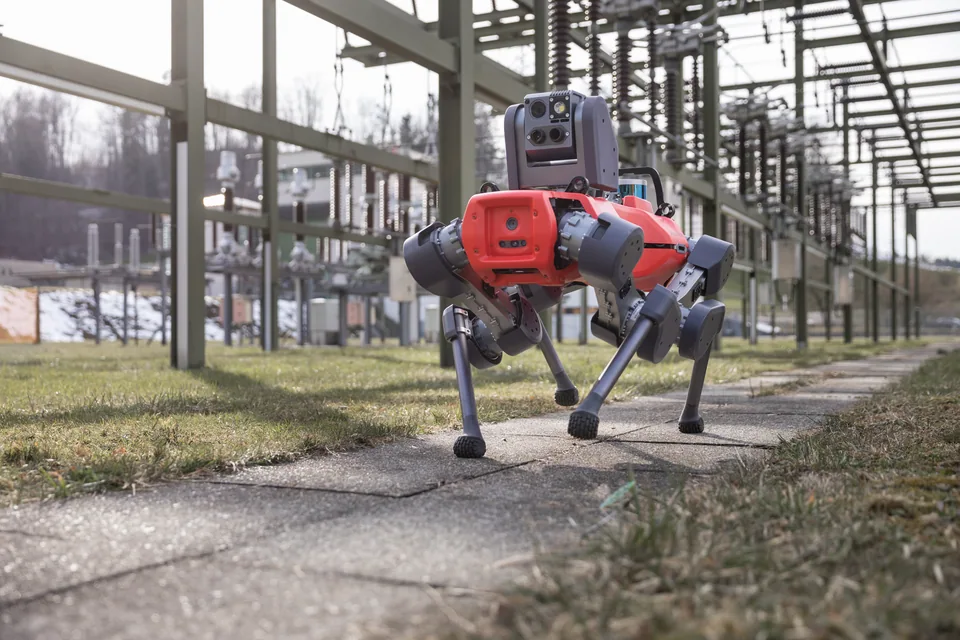
A comparison of the ANYbotics ANYmal D and the Boston Dynamics Spot. Both robots are quadrupeds with 12 degrees of freedom (DOF) and the same battery life of about 1.5 hours. What separates them is philosophy. The ANYmal D from Swiss ANYbotics is designed as a ready-made industrial inspection kit, while the Spot from Boston Dynamics is a general-purpose carrier onto which the user mounts a payload of their own. So the real question is not “which is better” but whether you are buying a finished inspector or a platform for your own sensors. We cover the whole class in the quadruped robots category and in the article “Quadruped Robots: Uses in Inspection, Security and Industry”.
ANYbotics AG
| Feature | ANYbotics ANYmal D | Boston Dynamics Spot |
|---|---|---|
| Manufacturer | ANYbotics AG | Boston Dynamics |
| Price (PLN) | no data | approx. 288,800 PLN* (≈ EUR 66,060)(converted from 74,500 USD, NBP rate 3.8762, as of 1 October 2026) |
| Height (cm) | no data | 61.0 |
| Weight (kg) | no data | 33.8 |
| Degrees of freedom | 12 | 12 |
| Payload (kg) | 10.0 | 14.0 |
| Speed (m/s) | 0.75 | 1.6 |
| Runtime (h) | 1.5 | 1.5 |
| Status | on sale | on sale |
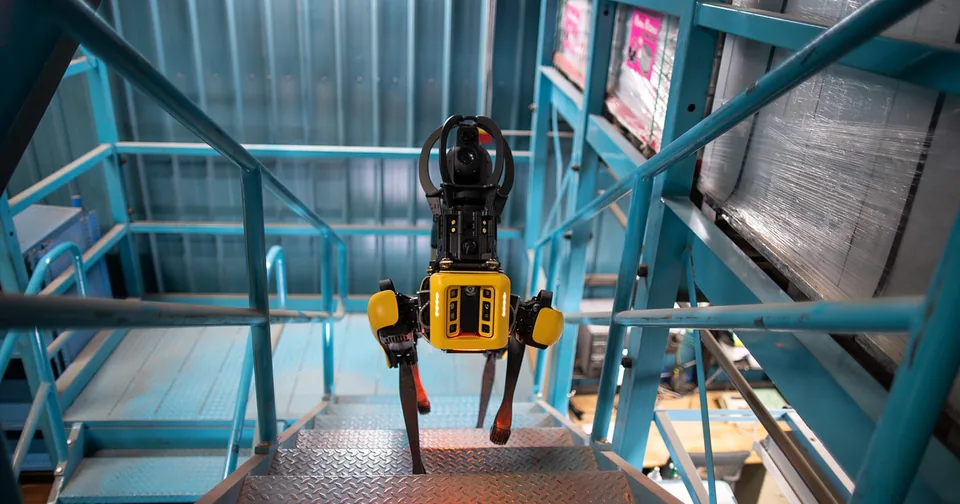
On paper the differences show up immediately. Spot weighs 33.8 kg, stands 61 cm tall, moves at up to 1.6 m/s and carries up to 14 kg on a swappable mounting plate. The enclosure is rated IP54, and the operating range runs from −20°C to 55°C. The 564 Wh battery gives roughly 90 minutes, and a full charge takes an hour. As standard the robot has all-round cameras with a 4 m range; everything else is added by the user.
The ANYmal D walks more slowly, at up to 0.75 m/s (the manufacturer quotes a range of 0.23–0.75 m/s), and carries up to 10 kg of additional payload, but it is better sealed at IP67. Its sensing is built in: a camera with 20x optical zoom, a thermal camera covering −40 to 550°C, a 360° LiDAR scanner, an ultrasonic microphone (0–384 kHz), six depth cameras, floodlights of up to 3,790 lm and two 8th-generation Intel i7 processors. The robot connects over WiFi and 4G/LTE. Fast charging to 70% takes 100 minutes and a full charge three hours, with a range of up to 2 km per charge. Spot is therefore more than twice as fast and carries more, while the ANYmal D offers better protection against water and dust and a far richer sensor set out of the box.
Neither manufacturer publishes a price list. ANYbotics sells the ANYmal D only on request for a quotation, so nothing reliable can be written about its price. For Spot there is an external source from mid-2020 quoting USD 74,500. Converted today that would be around PLN 288,777 (≈ EUR 66,060), but it is an indicative figure rather than a current offer, and a configuration with an arm or a sensor package costs more than the base robot.
There is no confirmed official distributor for either model in Poland. Buying means talking to the manufacturers' sales teams, often under an enterprise-type contract. Beyond the robot itself you need to budget for route-planning software, service, operator training and spare batteries. The Spot calculation is unpacked in the article “Boston Dynamics Spot: Price, Uses and Availability in Poland”, and general rules for costing robots are covered in “Humanoid Robot TCO: How to Calculate Total Cost”.
The ANYmal D is aimed at energy, water and gas utilities, heavy industry and mining. The thermal camera picks out overheating bearings, the ultrasonic microphone hears leaks of compressed air or gas, and the lighting lets it work in dark halls. This is cyclical-round work in a factory, where the robot collects data from the same points and compares it with earlier passes.
Spot has a wider field: industrial inspection, documenting progress on a construction site (the same route, the same shot, every week) and patrolling sites in a security role. Its strength is the mounting plate, which can carry a scanner, a thermal camera or a gas sensor. Anyone who needs one robot for several different tasks will choose Spot. Anyone with a single, well-defined diagnostic task will gain from the ANYmal’s ready-made kit. For smaller plants that want Polish-language support there is a third route, the MAB Robotics Honey Badger 4.0.
The ANYmal D stands out for its rich, highly specialized sensing for industrial inspection: a thermal camera working from -40 to 550°C, a 20x optical zoom and an ultrasonic microphone for detecting leaks, a kit that goes well beyond Spot's general-purpose vision system. Both robots aim at similar industries, namely energy, mining and heavy industry, but the ANYmal D moves more slowly, at 0.75 m/s against Spot's 1.6 m/s, which suggests a focus on measurement accuracy rather than travel speed. Runtime is identical, 1.5 hours for both. Neither manufacturer publishes a price outright, and ANYbotics sells the ANYmal D only on the basis of an individual quote. For tasks that need precise thermal and acoustic diagnostics of installations, the ANYmal D has the hardware advantage; for general mobility and quick visual inspection, Spot remains the more versatile.
For a maintenance department in energy, gas or mining that wants to detect leaks and hot spots without building its own sensor kit, the ANYmal D is the better choice. For a plant that starts with visual inspection, expects to add its own devices later and values a mature ecosystem and higher speed, Spot is the more sensible pick. For schools, universities and small firms neither is a natural choice: the prices are out of reach of a typical budget, and cheaper quadrupeds such as the Unitree B2 have a different profile. Before deciding, ask both sales teams for a quote on an identical inspection scenario and compare it with the cost of assembling your own sensor kit.
From -40 to 550°C, which lets it detect both overcooling and overheating in industrial installations.
Spot, at 1.6 m/s, more than twice as fast as the ANYmal D (0.75 m/s).
No. ANYbotics sells it only on individual quotation, with no published price list.
From −40 to 550°C. That lets it catch both overheating components and cooled-down parts of an installation.
Spot, at up to 1.6 m/s. The ANYmal D reaches up to 0.75 m/s, less than half that value.
No. The ANYmal D is sold only on request for a quotation. For Spot there is only an indicative source from 2020 (USD 74,500), and the manufacturer does not publish prices.
The ANYmal D is rated IP67 and Spot IP54. The first survives immersion in water, the second is protected against dust and splashes.