prototype
Manufacturer
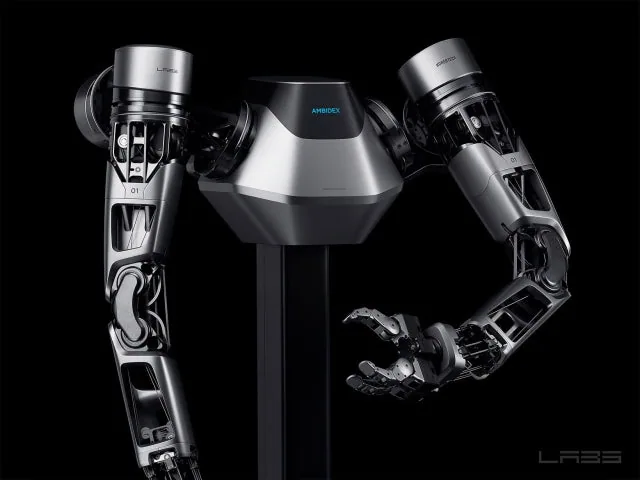
Korean AMBIDEX (2.6 kg per arm, cable-driven) from Naver Labs: a research platform, not a commercial product.
Naver Labs is the research and development company of the Korean internet giant Naver, operating since 2017 in Seongnam. Its flagship robotics project is AMBIDEX, a lightweight cable-driven robotic arm weighing 2.6 kg per arm, designed for safe interaction with people.
The platform has evolved, gaining a head with sensors, a torso and hips, moving closer to a more humanoid form, but it remains a research platform, not a commercial product. Compared with European research projects of a similar class, such as TIAGo from Spain's PAL Robotics, AMBIDEX focuses more narrowly on the mechanics of the arm itself and on safe physical contact, rather than on a full mobile service platform.
The company does not disclose project funding, commercialization plans or any presence of the technology in Europe or Poland.
That is important context: it is not a robot maker in the classic sense but a corporate laboratory that builds technology demonstrators. Its flagship robotics project is AMBIDEX, a lightweight cable-driven robotic arm designed for safe interaction with people. Each arm weighs 2.6 kg, less than a human arm. The platform has evolved: from arms alone it grew into a design with a sensor head, torso and hips, approaching a humanoid form. Demonstrations have included table tennis, assembly work and kitchen tasks. Public sources give no data on the project's funding, valuation or headcount, and the company does not state plans for commercialisation. The history of AMBIDEX is therefore the history of one research project and its successive versions, not of a product line. Such a way of working is typical of laboratories tied to large technology companies: it lets them test ideas without sales pressure, but also makes it hard to judge whether and when the technology will reach customers. We explain cable drive and its significance for safety in “Actuators in Humanoid Robots”.
Naver Labs' portfolio in our overview is a single project: the Naver Labs AMBIDEX. It is a two-armed robot in a unique cable-driven architecture, instead of classic gearboxes. Each arm weighs 2.6 kg, has 7 degrees of freedom and lifts up to 3 kg, and the declared movement speed reaches 5 m/s. The robot nonetheless remains safe in close contact with people, and force and touch sensors support the control. It learns control through teleoperation with a device that returns haptic feedback, which sets it apart from typical cobots programmed point by point. Machine learning is used to adapt force, speed and trajectory. The uses shown in demonstrations are precise manipulation: table tennis, assembly, kitchen work. The platform is intended for research and industry, but there is no official price list or full public specification. You will find wider context for the category in cobots, and the notion of parameters in “Degrees of Freedom (DOF) in Humanoid Robots”. The difference between a cobot and an industrial robot is explained in “Cobot or Industrial Robot”. The maker does not give the dimensions of the whole robot or its mass after the head and torso were added, so we do not quote those values.
Naver Labs does not compete in the sales market, because AMBIDEX is a research platform, not a product. Even so, it can be compared with other lightweight arms. Against light cobots such as the Franka Emika Panda or the dual-arm ABB YuMi IRB 14000 from ABB Robotics, AMBIDEX stands out for record lightness and arm speed while keeping safety. Of European research projects in a similar class, the closest is TIAGo from PAL Robotics, the PAL Robotics TIAGo. AMBIDEX nonetheless focuses more narrowly on arm mechanics and safe physical contact, not on a full mobile service platform. A similar direction of development, arms for working with people, is also represented by Universal Robots with its cobots, for example the UR3e, only in a commercial version. Naver Labs does not disclose data on funding or commercialisation plans, so we cannot judge whether the technology will reach the market.
AMBIDEX is not available in Poland or anywhere else: it is a Naver Labs technology demonstrator, with no sales, distributor or service. The maker discloses no data on the technology's presence in Europe, and we know of no Polish deployments. For a Polish reader the project has cognitive value: it shows what the next generation of light, safe arms might look like. If you are looking for an available cobot, start with the guide “How to Buy a Cobot Step by Step” and the explanation of the tax relief “Poland's Robotization Tax Relief”. There is neither a sale nor a rental, nor a programme for universities that would be open to Polish research units.
AMBIDEX is a fascinating research platform with cable drive and record-light arms, but not a product. There is no sale, price list or public specification, so there is nothing to recommend for purchase. It is worth following this project as a hint at the direction of development of collaborative robots and humanoids. If you are interested in concrete purchases, pick a cobot with an available price list and Polish service, and treat AMBIDEX as inspiration. It is a curiosity.
Naver Labs