pilot
Manufacturer
A German teleoperated humanoid, Robody, for senior care; piloted in VR, technical data unknown.
Munich-based Devanthro GmbH builds “Robody”, a teleoperated humanoid avatar controlled remotely in VR by human pilots, intended for elderly care and assistance at home. The company claims a target market worth more than USD 500 billion, but this is its own estimate, not an independently verified figure.
Unlike fully autonomous humanoids such as China's Unitree models, Robody relies on the precision of a human “in the loop”, with autonomy planned to increase gradually; first real-world deployments were signaled from 2024. The manufacturer does not disclose height, weight, degrees of freedom or the price of the device.
For the European senior-care market it is one of the few local projects, worth watching but still at an early stage of commercialization.
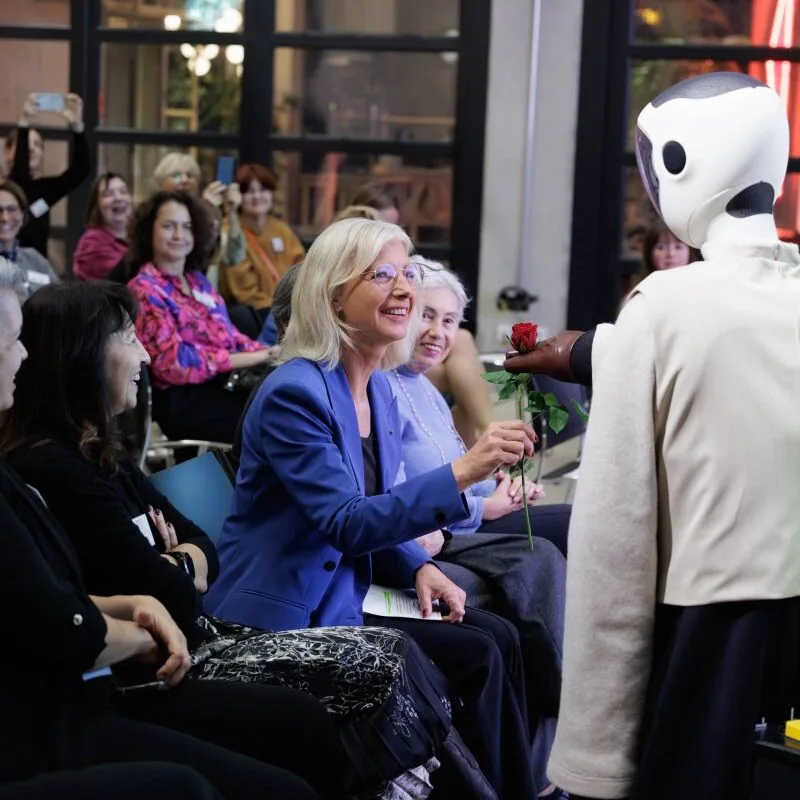
Devanthro GmbH of Munich is one of those companies about which you know exactly as much as the founders choose to say. The founding year does not appear, but the direction is clear from the first sentence on the website: “Robody” is meant to be a humanoid avatar that a human “steps into”. A pilot in VR goggles, with haptic feedback and stereo vision, controls the robot as if they had their own hands in someone else's home. The company has signaled first real-world deployments from 2024, and among the sources for this description is also a partner mention on Infineon's website. That is an important difference from makers who promise full autonomy right away: Devanthro first collects data from the work of human pilots and only then intends to gradually hand routine tasks over to artificial intelligence. The company gives its own estimate of the care and home-assistance market at more than USD 500 billion. That number should be treated as a claim, not the result of an independent analysis. The stage of development is a pilot, not serial sales, and the manufacturer has not yet published height, weight, degrees of freedom or price.
Devanthro's portfolio is so far a single robot, but with a clearly defined role. Devanthro Robody is a teleoperated, electrically driven humanoid fitted with RGB+Depth stereo cameras and a soft, flexible “skin” meant to ensure safe contact with the household member. Computation is split between edge AI and the cloud. The manufacturer shows two-handed tasks: from handing over objects to playing board games, and eventually helping with shopping, handing out pills and simply keeping someone company at the table. In our classification Robody belongs to the category “Humanoid robots” and fits the application “Home”, though it is closer to a care service than to off-the-shelf hardware. The difference between teleoperation and full autonomy is explained in the article “VLA Models: How AI Controls Humanoid Robots in 2026”, and the construction of hands and joints is described in “Actuators in Humanoid Robots”. The data that would allow Robody to be compared numerically with other designs is missing; how to read such gaps is shown in “How to Read a Robot Datasheet”. For a comparison with fully autonomous machines, also see the roundup “Unitree H1, G1, R1 and H2”.
In the market, Devanthro occupies a niche where competition is surprisingly thin: a teleoperated humanoid for senior care. The company itself compares itself with fully autonomous humanoids, such as designs from Unitree Robotics, which have detailed spec sheets and public prices, for example Unitree G1. Another point of reference is Figure AI with the Figure 02 model, built for factory work rather than for an elderly person's home. Data on funding, valuation or number of customers is not published, so we don't judge the scale of the company. A strength is the documented precision of manipulation in teleoperation; weaknesses are total dependence on the pilot for complex tasks and undisclosed unit economics: somebody has to pay the operator for every hour of the robot's work. Until that calculation is shown, it is hard to say whether the business model is cheaper than an ordinary caregiver, and that is a question not only customers but also investors will ask.
Robody is not available in Poland and no distributor or dealer has been named. We also know of no deployments or pilot projects in Polish care homes or at universities, and Devanthro has not published plans to enter the Polish market. An interested facility would have to contact the Munich company directly, with no guarantee of getting an offer, because the model is in a pilot phase. We write more about how humanoids are changing the labor market in our country in the article “Humanoid Robots and the Polish Labor Market”. If public information about Polish trials appears, we will add it here with the source.
Devanthro is a project to watch, not to buy. The idea of teleoperation with learning AI is sensible and honestly described, but without a price, technical data and availability in Poland there is nothing to deploy. For European senior care, it is worth following whether the pilot turns into a service in which the cost of an hour of work can be calculated. Anyone looking for ready-made care hardware today should check the category “Home robots” instead of waiting for Robody to be commercialized.
Devanthro GmbH