on sale
Manufacturer
CMR Surgical: Britain's Versius, a unicorn since 2019, a $600 million Series D and more than 20,000 procedures.
Versius, the modular surgical robot from Britain's CMR Surgical, has come a long way: from the startup Cambridge Medical Robotics (renamed CMR Surgical in 2018), to unicorn status in 2019, to a $600 million Series D round in 2021 at a $3 billion valuation, described as the largest private funding round in medtech history.
Founded in 2014 in Cambridge, with manufacturing in Ely, the company employs about 650 people and by 2024 had passed 20,000 procedures performed; its new UK factory has a production capacity of 500 systems a year. In robotic surgery Versius competes mainly with the da Vinci (Intuitive Surgical), offering a modular design instead of one large console, which is meant to ease adoption in smaller operating rooms.
Presence in Poland is unconfirmed.
CMR Surgical began as Cambridge Medical Robotics. The company was founded in 2014 in Cambridge, and its production operates in Ely, Cambridgeshire. In 2018 it changed its name to CMR Surgical and in the same year showed the Versius system (September 2018). A year later, in 2019, the company reached unicorn status, and in 2021 it closed a Series D round of $600 million at a $3 billion valuation. According to descriptions it was the largest private funding round in the history of medtech.
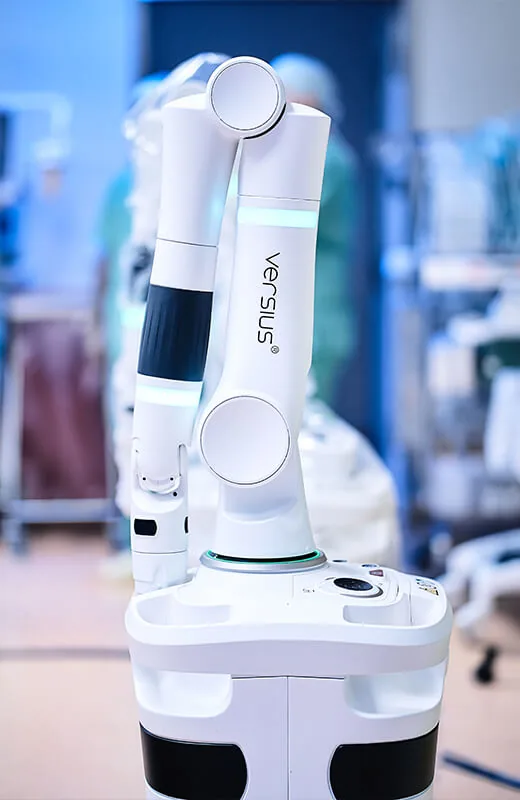
The philosophy of Versius is modularity instead of one big column: several independent arms that can be positioned around the patient like separate carts.
The scale of operations is growing. The company employs about 650 people, and by 2024 it had passed 20,000 procedures performed. The new UK factory has a production capacity of 500 systems a year. We describe the Polish and global background of this field in “da Vinci Robots in Polish Hospitals”, and an overview of robots for medical use is collected at hospitals.
CMR Surgical's offering is one system: Versius. It is a modular surgical robot for robot-assisted laparoscopic procedures. According to the manufacturer's description it has a V-Wrist with 360 degrees of movement and seven degrees of freedom per arm. Sales began in 2019, and the company does not disclose the system's price.
The modular design is meant to ease adoption in smaller operating rooms, because instead of one large console with arms mounted on a common cart there are separate modules. Whether this is really an advantage depends on the hospital, and it is decided only by clinicians' experience. The concept of degrees of freedom is explained in “Degrees of Freedom (DOF) in Humanoid Robots”.
The reference point for Versius is da Vinci 5, the newer system of the da Vinci family. The Hugo RAS from Medtronic plc (Hugo RAS) belongs to the same class, although the technical data for that system remains unconfirmed in our catalog. The whole class of medical machines is described in “Specialist robots”. For a hospital what counts is not only the robot itself but also team training, the availability of single-use instruments and service. The manufacturer does not give that data in its description, so it has to be obtained in a sales conversation.
CMR Surgical's position is well described by figures that can be checked in the sources: a $600 million Series D, a $3 billion valuation, about 650 employees, more than 20,000 procedures by 2024 and a production capacity of 500 systems a year. That is the profile of a serious player, but not a leader at mass scale.
The main competitor is Intuitive Surgical, the maker of the da Vinci system, which for years has defined the segment. CMR answers with modularity and positioning for smaller rooms. The third player in our catalog is Medtronic plc (Hugo RAS) with the Hugo RAS system.
It is also worth remembering the Polish research thread: Fundacja Rozwoju Kardiochirurgii im. prof. Zbigniewa Religi of Zabrze has been developing the Robin Heart program, a Polish robot for heart surgery, since 1991. It still has research status, so it is not a direct commercial competitor. A scale of more than 20,000 procedures is impressive, but in surgery the quality of clinical outcomes matters too, and we do not assess those publications in this entry.
CMR Surgical's presence in Poland is unconfirmed. We list no Polish distributor, no list of hospitals and no Polish price.
We describe the Polish market for surgical robots through its competitor, in “da Vinci Robots in Polish Hospitals”. The Polish research path is represented by Fundacja Rozwoju Kardiochirurgii im. prof. Zbigniewa Religi of Zabrze, described as a research program, not a commercial product. A hospital considering a system of this class must first check the availability of training and service in Central Europe, as well as the question of financing the purchase. There is no confirmation that Versius works today in any Polish hospital, so we do not suggest such a presence. A facility that wants to compare systems should set Versius against da Vinci 5 and ask the manufacturer for Central European references.
Versius is a serious, well-funded system with a real track record of procedures, but without confirmed presence in Poland and without a public price. For a hospital that means negotiating directly with the manufacturer. First set it against da Vinci 5. If you want an alternative to the da Vinci, Versius deserves a sales conversation. Take into account the costs of single-use instruments and service. Also look at specialist robots to see what the whole group of medical machines looks like.
CMR Surgical Ltd.