In this article
Key facts
- Models coveredUnitree H1, Tesla Optimus Gen 3
- Prices of the models covered439,000 PLN (≈ EUR 99,660 at NBP rate 4.4048 of 16 November 2026)
- Covered models available in Poland1 of 2
- Number of sources6
- Reading time5 min
Why the actuator is one of the most important (and most expensive) design decisions
An actuator is the assembly of an electric motor, a gearbox (if there is one), an encoder and control electronics that drives a single joint of a robot. It determines how many kilograms the robot can lift, how precisely it places its foot and — ever more important when working alongside people — how "softly" it reacts to unexpected contact. In humanoid robots, where the number of powered joints runs to several dozen (see “Degrees of Freedom (DOF) in Humanoid Robots”), the actuators are usually among the most expensive items in the price of the whole machine.
Three solutions compete today for a place in humanoid designs: harmonic drives (strain wave gears), planetary roller screws, and quasi-direct drives (QDD). None is universally "best" — each is a compromise between mass, torque, precision, price and behavior on contact.
Harmonic drive (strain wave gear)
A strain wave gear is a mechanism built from three elements: a rigid, elliptical wave generator; a flexible toothed sleeve (the flexspline), deformed by that generator into an oval shape; and a rigid outer gear (the circular spline) with slightly more teeth than the flexible sleeve. Because the teeth mesh at only two opposite points of the ellipse, and the tooth counts usually differ by two, this difference translates into a very high mechanical reduction — from 30:1 to 320:1 in a single stage, as the manufacturer, Harmonic Drive, states.
Strengths: virtually no backlash between the teeth, high positioning precision, low mass and volume for the reduction achieved, and coaxial input and output.
Weaknesses: at low loads the gear behaves like a torsion spring ("wind-up"), which complicates precise force control; making the flexible sleeve demands tight tolerances, which raises the price.
The harmonic drive has been a standard in industrial and space robotics for decades — a mechanism of this type drove the wheels of the Apollo 15 lunar rover (80:1 reduction, Harmonic Drive). In humanoids it works especially well in joints that need high precision at moderate load, such as the wrist or shoulder.
Planetary roller screws
A planetary roller screw converts rotary motion into linear motion — like a ball screw, but instead of balls it uses several rollers arranged radially around a central threaded spindle, rotating and at the same time orbiting it like satellites, much as in a planetary gearbox.
Strengths: higher dynamic load capacity than a ball screw of comparable size, tolerance of high shock loads, small space requirements and a much longer service life — as described, among others, by the actuator maker Tolomatic.
Weaknesses: price — planetary roller screws are usually clearly more expensive than a comparable ball screw because of the number of precisely made rolling elements (we give no specific multiple because we found no reliable primary source for one).
In humanoid robotics this type of drive is used in heavily loaded linear joints — typically the hip and knee, where the robot must generate large forces to lift its own body weight and keep its balance, while staying compact.
Direct drive and quasi-direct drive (QDD)
A direct drive transmits torque from the motor to the output with no intermediate gearing at all. The concept of a direct-drive robot arm was described in 1981 by Haruhiko Asada and Takeo Kanade of Carnegie Mellon University (CMU report): rare-earth torque motors have enough torque and low enough mass that the arm links can be coupled directly to the motor rotors without gearing.
Strengths: smooth torque transmission, virtually zero backlash, low inertia, fast response and, above all, good backdrivability: a joint can be moved from outside and the robot will feel it. This is crucial for working close to people and for a natural, compliant gait.
Weaknesses: it needs special motors with high torque at low speed, it is more prone to cogging (jerky "catching" of the torque), and under heavy loads a motor without gearing has to be physically large and heavy.
Quasi-direct drive is a practical compromise: it adds a single low-ratio gear stage (often planetary) to raise the achievable torque without losing most of the benefits of direct drive — especially backdrivability and a natural sense of contact force. It is a favorite in quadruped robots and in the legs of humanoids, where contact with uneven ground calls for a fast, "soft" response from the drivetrain.
What it costs in practice — an example from the market
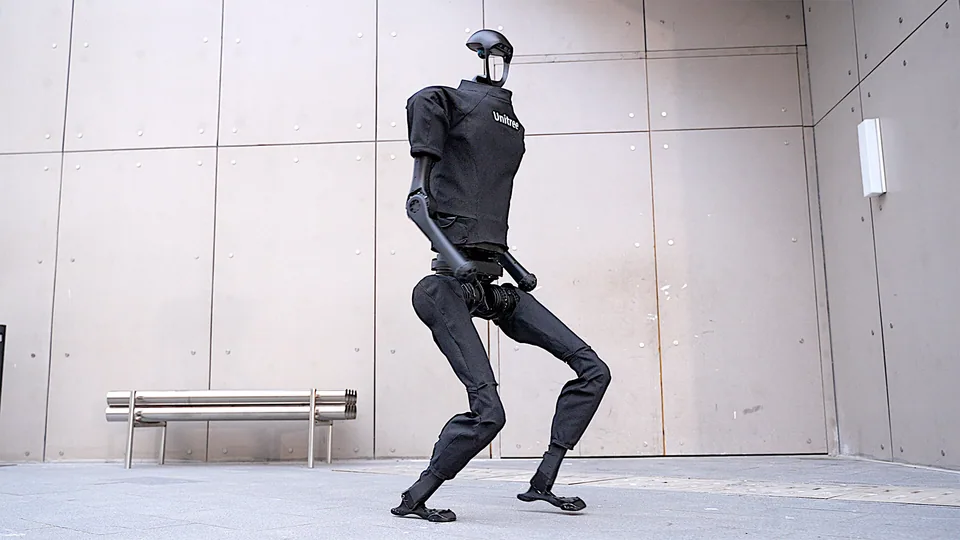
Concrete numbers on datasheets show how these choices turn into real specifications. Unitree G1 states a maximum knee-joint torque of 90 N·m in the base version and 120 N·m in the EDU version (Unitree). The manufacturer does not explain the difference; it may reflect a different actuator set, but that is our conjecture. At the other end of the price scale stands Unitree H1, priced at $90,000 in Unitree's shop, although the page indicates that the actual price depends on contacting sales (Unitree shop).
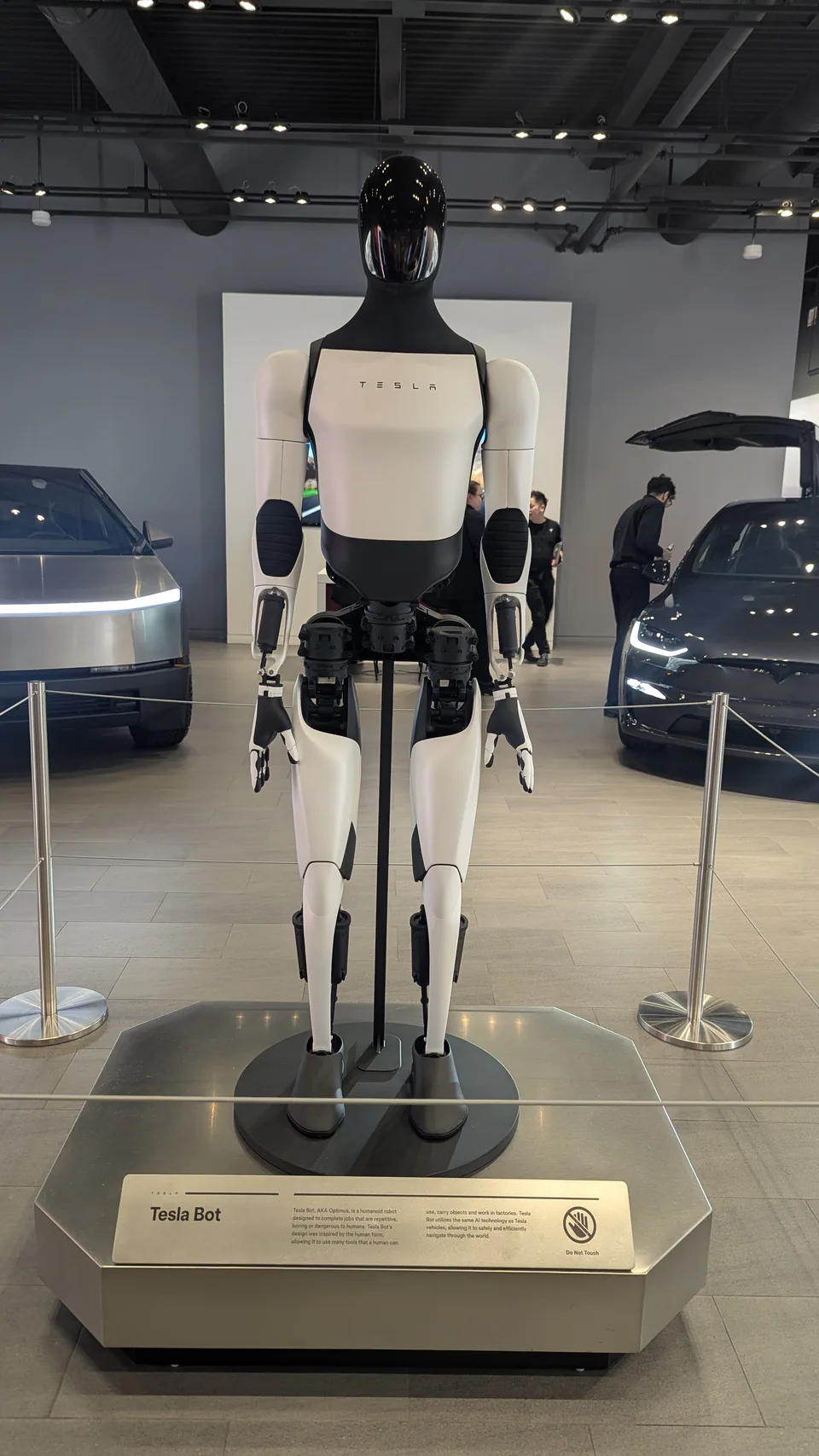
The Tesla Optimus Gen 3 model goes toward the maximum number of independent drives in the hand — according to reports based on Tesla's statements and materials (the manufacturer has not published a Gen 3 datasheet), the hand's drives are to sit in the forearm and move the fingers via tendons, and the hand is to have 22 degrees of freedom — an approach closer to the biomechanics of the human hand (remotely driven tendons) than to the classic actuators placed directly in the finger joints.
How this affects the choice of robot
When comparing models in the humanoid robots category, keep in mind that the actuator type itself is rarely stated outright on a manufacturer's datasheet — more often you have to infer it from context (torque, mass, stated compliance on contact) or from independent technical reviews. Before paying for a robot with a specific application in mind — for example, working near people on a production floor — check not only the total DOF count (see “Degrees of Freedom (DOF) in Humanoid Robots”) but also whether the manufacturer declares a safe, compliant response to contact at all, since that is a direct consequence of the choice of drive type. How to read the rest of such a datasheet step by step is explained in “How to Read a Robot Datasheet”.
Frequently asked questions
How does a harmonic drive differ from an ordinary gearbox?
A harmonic drive (strain wave gear) uses a deformable flexible toothed sleeve instead of rigid gear wheels. According to the manufacturer Harmonic Drive, with only three components it achieves ratios from 30:1 to 320:1 in a single stage, with virtually no backlash, at the cost of more complex manufacturing and a higher price.
What is quasi-direct drive (QDD)?
It is a drive with minimal gearing (usually a low-ratio, single-stage reduction) that keeps much of what makes direct drive attractive — above all the ability to push the actuator around from outside (backdrivability) and a natural feel for contact with the surroundings — while raising the torque available compared with a pure direct drive.
Why are actuators among the most expensive parts of a humanoid robot?
Because they combine requirements that are hard to reconcile: high torque at low mass, positioning precision, resistance to shock and — increasingly — safe, compliant behavior on contact with people. Meeting all of these at once takes expensive materials, tightly toleranced manufacturing and often motors with rare-earth magnets.
Do cheaper robots have worse actuators?
Usually yes, but not always in a straightforward way — a cheaper model may deliberately use simpler drives in lightly loaded joints (the wrist, for example) and more expensive ones where strength matters (the knee, for example), as seen in the torque difference between the standard and EDU variants of the Unitree G1.
Sources
Links to the material this text is based on. Before you base a decision on a figure from the article, check it at the source.
About the authors
A chief engineer by profession (technical head of a ship's machinery plant, licensed). Sets the site's editorial rules and is responsible for them; he does not read every page before publication.
Texts are prepared by the editorial team using AI tools. We compare data with primary sources on a sample basis, not page by page. Our rules are described here: How we check · About us