on sale
Manufacturer
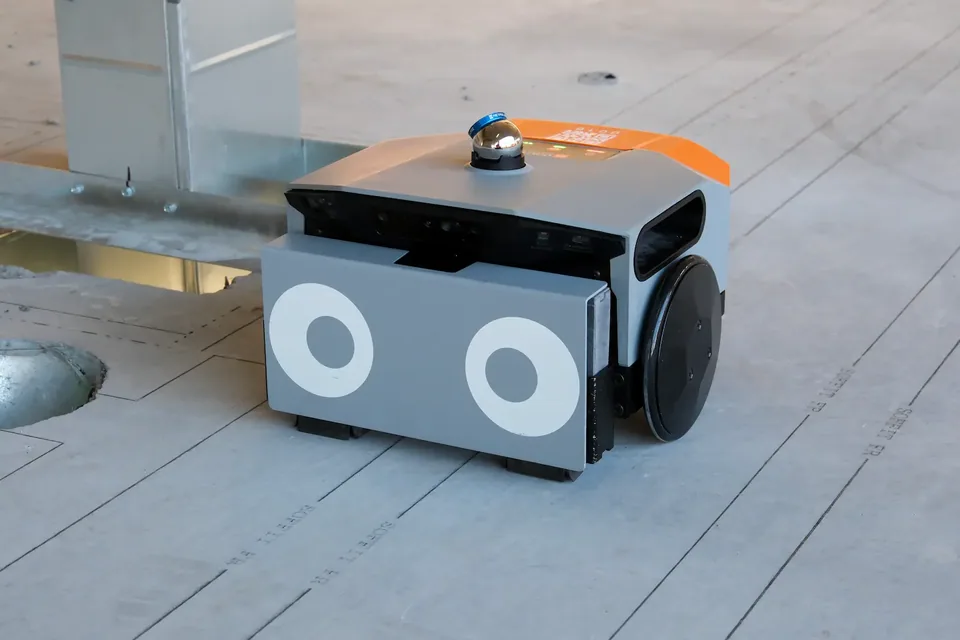
Dusty Robotics FieldPrinter: a robot that prints building layouts on the floor with 1/16-inch accuracy; US only.
The FieldPrinter, a product of the American company Dusty Robotics, is a mobile robot that prints full-scale building layouts (walls, MEP service markings, QR codes) directly onto the floor of a construction site, with a stated accuracy of up to 1/16 inch. The system uses AI-based computer vision and obstacle avoidance, so a single operator can run it without extra surveying staff.
The manufacturer states availability in North America only, which makes expansion into Europe and Poland an open question, unlike more globalized solutions such as the agricultural robots from Ecorobotix. In construction robotics the FieldPrinter stands out for a narrow, well-defined niche, building layout, rather than broad autonomy, which lowers deployment risk but also limits uses beyond that one task.
Dusty Robotics of the USA shows that a robot on a building site does not have to look like a person. The founding year and headquarters were not given in verified sources, but the product is described in detail. The FieldPrinter is a mobile printer that moves across the floor of a construction site and lays down a full-scale plan: wall lines, MEP service markings, QR codes. The manufacturer states an accuracy of up to 1/16 inch, or about 1.6 mm. In January 2024, TechCrunch wrote about a new version of this layout robot. The idea is simple, and therefore apt: until now, layout was marked by a person with chalk or string, whereas the robot does it in ink, completely and faster. The system uses AI-based computer vision and obstacle avoidance, so one operator can run it, with no additional survey crew. The company's story is therefore the story of one well-chosen application, not a broad platform, and that focus is part of its credibility. For a Polish reader it is a good example of how construction robotics does not begin with humanoids but with tedious, repetitive tasks in which a mistake costs money, because a wall shifted by a few centimeters means a clash with the services. For the wider context of automating work on building sites, see the category “Specialist robots”.
The portfolio is limited to a single model, Dusty Robotics FieldPrinter, which weighs 10.43 kg and has an electric mobile-platform drive. It prints full-scale plans directly on the slab, and crews from different trades use them at the same time. The manufacturer states that layout can be up to ten times faster than by manual methods, a claim that has not been independently verified. The FieldPrinter belongs to specialist robots and is an example of the construction site application. The price is not disclosed. If you want to understand how to assess such claims, see “How to Read a Robot Datasheet”, and for how to calculate the return on investment in a robot, see “Humanoid Robot TCO: How to Calculate Total Cost”. QR codes on the floor let you link a location with documentation, and the MEP markings make life easier for installers. The manufacturer gives neither a price nor a load capacity, and states the 10.43 kg weight in the technical data, which points to a small platform compared with agricultural robots such as Ecorobotix ARA.
Dusty Robotics works in a niche that is hard to compare with the popular humanoids. Its direct competitors are other systems that print layouts on the floor, but we have no data on them, so we do not set specifications side by side. Closer in working environment are field robots such as ANYbotics ANYmal D from ANYbotics or Boston Dynamics Spot from Boston Dynamics, which can inspect a building site but do something entirely different. There is no information on funding, customers or valuation. The manufacturer states availability in North America only. The biggest asset is the elimination of errors in manual layout, along with several crews working at once; the biggest weaknesses are limited market reach and no public price. The customer is a general contractor coordinating many trades on one site, not a small firm: such a profile suggests a B2B strategy built on contracts, not over-the-counter sales. For a comparison of the economics of deploying robots in construction, see “Humanoid Robot TCO: How to Calculate Total Cost”.
The FieldPrinter is not officially available in Poland. According to the manufacturer's website, the system is sold in North America, and no distributor in Poland was found. No Polish construction company appears in our catalog as a user. A Polish general contractor who wanted to lay out with a robot would have to contact Dusty Robotics directly and accept that there would be no on-site service. A related topic, tax relief on robot purchases, is covered in “Poland's Robotization Tax Relief” (Poland's robotization tax relief, ulga na robotyzację). In the meantime, Polish firms interested in automating building work can check whether local integrators offer comparable services, described in the section “Polish Robotics Companies”.
The FieldPrinter is a clever tool with a clear use, but for now out of reach for Polish construction firms. It is worth following the company, because the idea of printing plans on the floor will sooner or later appear in Europe too, and then the comparison will be easier. For a Polish contractor it is, for now, inspiration, not a commercial offer. If the company opens up to Europe, we will come back to the assessment with a price and local service.
Dusty Robotics