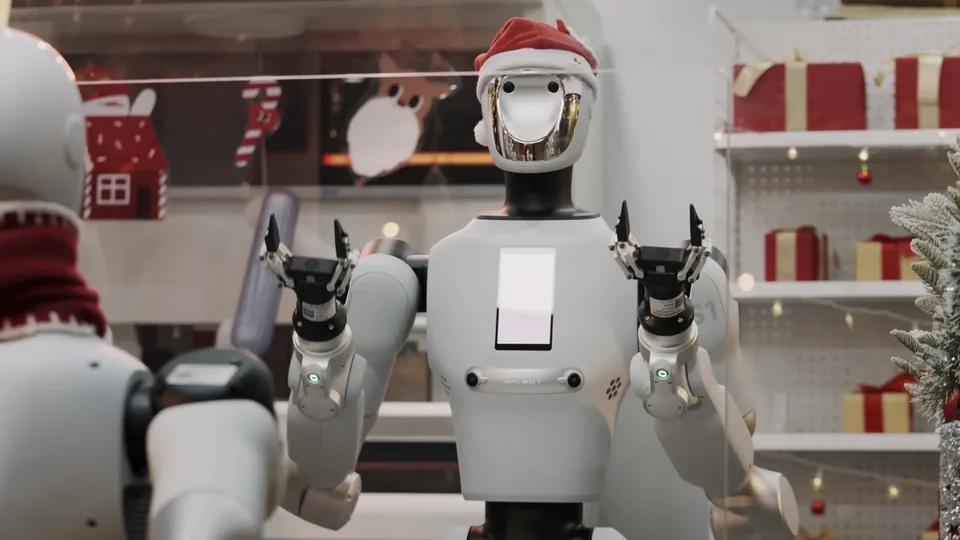
prototype
Galbot (Beijing Galaxy General Robot Co., Ltd. / Beijing Galbot Co., Ltd.)Humanoid robots
Galbot G1
- 173 cmheight
- 10 kgpayload
- —price
Manufacturer
Galbot (Beijing, 2023): $986 million raised, $3 billion valuation. G1 runs shops, S1 works at CATL.
Behind Galbot (full name: Beijing Galaxy General Robot / Beijing Galbot) stands the duo of Yao Tengzhou and Wang He, the latter a professor at Peking University and head of a research center for embodied intelligence. The company was founded in May 2023 and in under three years raised about $986 million, reaching a valuation above $3 billion, a pace comparable to Figure AI or Unitree.
The flagship G1 is a wheeled humanoid with two arms that has run autonomous “Galbot Store” shops in more than 30 Chinese cities since 2026; the heavier S1 has worked on a CATL battery production line since spring 2026, and the ET1 debuted the same year. Commercial partners include Mercedes-Benz, Meituan, Bosch and CATL, which sets Galbot apart from firms focused purely on demos.
Model status: the G1 is still a prototype, while the S1 is already on sale. There is no distribution in Poland.
May 2023: the Beijing company Galbot is founded, and behind it stands the duo of Yao Tengzhou and Wang He. The latter is a professor at Peking University and heads a research center for embodied intelligence, which gives the company a strong scientific backing. In under three years it raised about $986 million and reached a valuation above $3 billion, a pace that sources compare with the story of Figure AI or Unitree Robotics. The company did not stop at demos: since 2026 the wheeled humanoid G1 has run autonomous “Galbot Store” shops in more than 30 Chinese cities, and the heavier S1 has worked since spring 2026 on a CATL battery production line. The same year saw the debut of a third model, the ET1, which is not yet in our catalog. Among partners, sources name Mercedes-Benz, Meituan, Bosch and CATL. The background to this wave is in “Chinese Humanoid Robots”, and factory applications in “Humanoid Robots in Factories 2026”. For scale: this is the pace at which only the most talked-about companies of this industry emerge, though most of the valuation rests on market claims, not on public financial statements. These numbers should therefore be read as a signal of direction, not as an audited result.
The two catalog models show the two faces of the company. Galbot G1 is a humanoid on wheels: 173 cm, 92.5 kg, 21 degrees of freedom and a 10 kg payload, working in shops. According to our sources its status is still prototype, even though the robot is already working in practice, and its price is estimated at $30,000 to $91,000, so the data diverges. Galbot S1 is an industrial dual-arm robot with a mass of 320 kg, 17 degrees of freedom and a 50 kg payload, on sale since January 2026, at a price the manufacturer does not disclose. The wheeled base is a deliberate compromise: instead of bipedal walking the company bets on stability and speed of deployment, whereas Agility Digit 5 bets on legs in warehouse scenarios. Useful background on the reality of the shop floor is in “Humanoid Robots in Factories 2026”, and the whole class is in humanoid robots. Applications in production are covered under “Factories and manufacturing”. It is important not to confuse the statuses: the G1 works in shops, yet is labeled a prototype, while the S1 is officially on sale. That shows a product label does not always match practice, which is why we read the status together with the description of applications, not instead of it. The G1's price depends on the source, so we treat none of the figures as official.
Galbot stands out for having real deployments, not just demos: shops in 30 cities and a line at CATL. A valuation of $3 billion on about $986 million of funding puts it among the leaders of the Chinese wave, above EngineAI Robotics, valued at $1.5 billion. Among commercial partners, sources name Mercedes-Benz, Meituan, Bosch and CATL. Competitors are Unitree Robotics, UBTECH Robotics with its Walker models and AgiBot, and in the West Figure AI and Agility Robotics. Risk: some of the data, such as the G1's price, comes from divergent estimates, so keep that in mind when judging scale. In this group Galbot is one of the few showing deployments in two different industries at once, retail and battery manufacturing. Companies such as Meituan or CATL are partners that can bring scale, but how deep that cooperation goes, our sources do not specify. Customer data should therefore be verified at every update and compared with the articles “Tesla Optimus: What We Actually Know (as of September 2026)” and “Figure 03: What We Know About Figure AI's Third-Generation Robot”.
Galbot has no distribution in Poland, and both models are recorded as not officially available. We also know of no Polish deployments or cooperation with universities. Indirectly, global partners such as Bosch create a local context, but that presence does not mean access to Galbot's robots. Anyone who wants to assess the real cost of such equipment will find a calculation in “Humanoid Robot TCO: How to Calculate Total Cost”, and the impact on the job market in “Humanoid Robots and the Polish Labor Market”. An interested company would have to reckon with direct import, CE certification and no local service, all before the first start-up.
Galbot is one of the most interesting companies of the Chinese wave, because it combines scientific backing with real deployments in retail and industry. For Poland, though, it is still a topic to watch: no distributor and an uncertain G1 price. It is worth following Galbot S1, since it has references on a factory floor and not only in shops, and comparing it with Galbot G1. For now, interest means watching rather than buying, and further deployments outside China will be the credible test.
Galbot (Beijing Galaxy General Robot Co., Ltd. / Beijing Galbot Co., Ltd.)