on sale
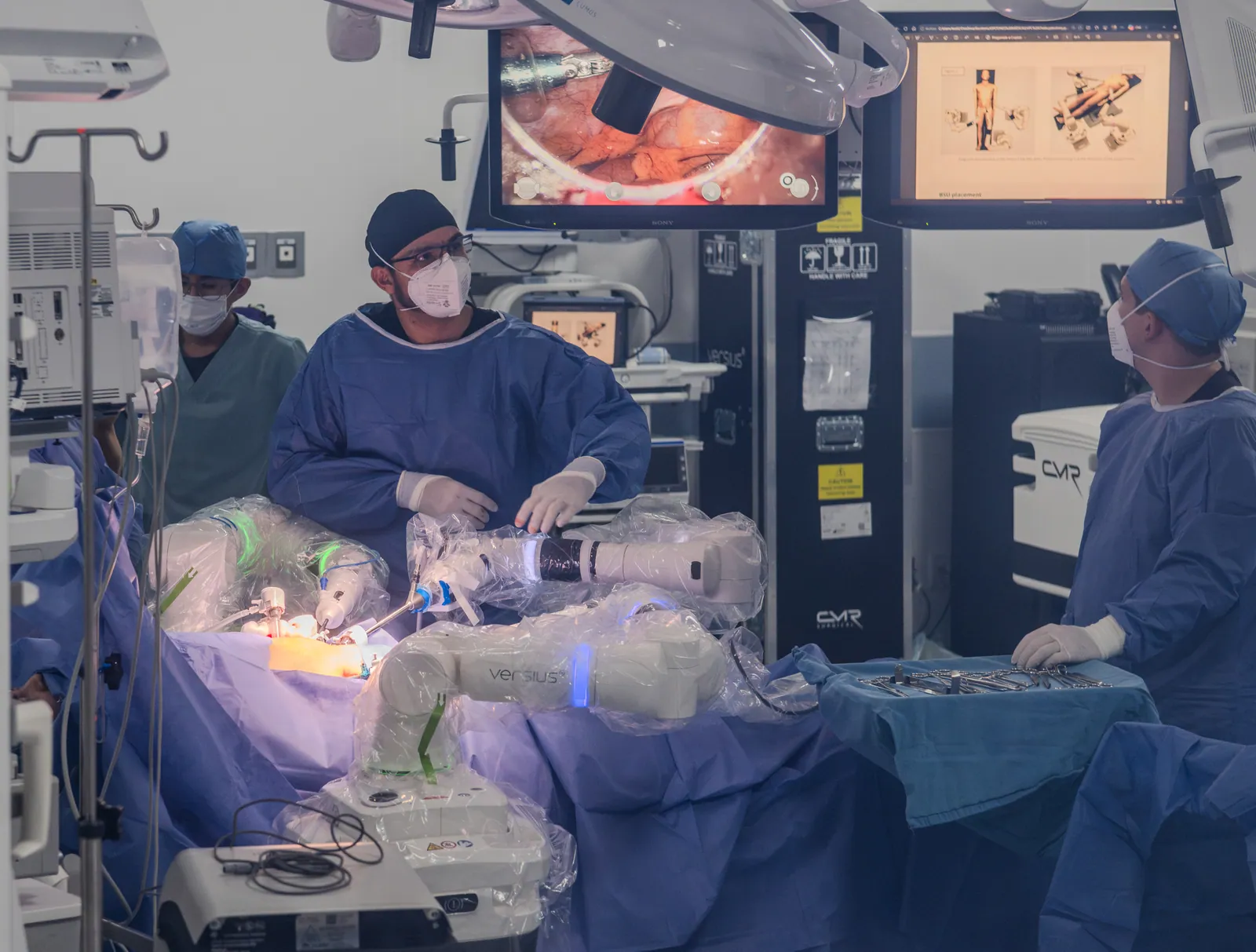
Versius attacks the surgical robotics market from a different angle than the dominant da Vinci: instead of one large console, the UK's CMR Surgical designed modular, independent arms that can be wheeled into a standard operating room without rebuilding the space.
The patented V-Wrist joint with full 360-degree rotation is meant to preserve the familiar laparoscopic port layout for surgeons, shortening the learning curve compared with the competition. The system is approved for use in Europe, Australia and Brazil; by 2024 more than 20,000 procedures had been performed with it, and the company's British factory can produce up to 500 systems a year.
The manufacturer does not state the price of the system or the cost of a single procedure. Compared with the da Vinci from Intuitive Surgical, which has a much longer clinical track record and a larger installed base, Versius wins on a smaller footprint in the operating room and the mobility of individual arms, but trails on the scale of clinical references.
CMR Surgical reached unicorn status in 2019, and in its 2021 Series D round it raised 600 million USD at a 3 billion USD valuation. A solution for hospitals looking for a flexible alternative to larger, less portable surgical systems.
Data from manufacturer datasheets and product pages; median over the models of this category in the database.
no data
Purchase: the manufacturer does not state the system price or the cost of a single procedure, and we have no reliable price list from tenders either. In the Polish context, we know that the average cost of an operation using the da Vinci robot is about 30,000 PLN (≈ EUR 6,870 at NBP rate 4.3641 of 21 October 2026), and in complex cases as much as 60,000 PLN (≈ EUR 13,750); that is data for the leader, not for Versius, and we give it only as an order of magnitude for robotic surgery. As an estimate, the purchase cost is joined by single-use or limited-use instruments, a service contract, team training and software updates. These are usually items of a weight comparable to the system price over several years, an industry rule of thumb that you should check in the offer. Training: surgeons must complete a certified program; the time depends on laparoscopy experience. A general way of analyzing costs is shown in “Humanoid Robot TCO: How to Calculate Total Cost”.
No confirmed distributor in Poland
Versius is used for robot-assisted laparoscopic surgery, that is, operations in which the surgeon works through small incisions, looking at a three-dimensional HD image and controlling instruments from a console. Versius takes a different route from the dominant da Vinci: instead of one big cart, it has modular, independent arms that staff wheel into a standard room without rebuilding it. The characteristic element is the patented V-Wrist joint with full 360-degree rotation. The manufacturer designed it to preserve the laparoscopic port layout that surgeons know, which is meant to shorten the learning curve compared with the competition. The robot has seven degrees of freedom, and its sensing includes 3D HD imaging and, since one of the updates, ICG fluorescence for assessing tissue perfusion. The application is robot-assisted laparoscopic surgery; the manufacturer's sources do not list specialties in detail, so we do not invent our own list. The general picture of robotic surgery in Poland is covered in “da Vinci Robots in Polish Hospitals”, from urology through general surgery to gynecologic oncology. This is equipment for the hospital setting only, and it falls under medical device regulations, not industrial robot standards. Its strengths are a smaller footprint in the room and the mobility of individual arms. On the weaker side, the scale of clinical references and the installed base are smaller than at the leader, da Vinci 5.
Worth considering for: hospitals that want to enter robotic surgery but have limited space or want to serve more rooms with a single set; centers that value flexible arm placement and a familiar port layout. Interested parties must verify regulatory approval in their own country: the system is approved for use in Europe, Australia and Brazil.
Who it is not for: a patient or facility looking for a “ready price”; the manufacturer does not state the system price or the cost of a single procedure, and a purchase decision means a tender and a long clinical analysis. Clinics whose surgeons are trained mainly on da Vinci and do not want to change platform. Neither this text nor our site is medical advice; the choice of surgical method is decided by the doctor. Facilities assessing availability in Poland should consult the overview in “da Vinci Robots in Polish Hospitals”.
According to the manufacturer, more than 20,000 procedures had been performed with Versius by 2024, and the system is approved in Europe, Australia and Brazil. That is the only figure we treat as confirmed; we have no list of hospitals. In Poland, Versius is counted in the overview of robotic surgery systems alongside da Vinci, Hugo and Edge Medical, with over 100 installations in total as of January 2026, though Versius's share is not broken out. We have not confirmed specific facilities with Versius, so we give no names. No confirmed, named deployments in Poland; the national context is in “da Vinci Robots in Polish Hospitals” and in the category “Specialist robots”.
da Vinci 5: the fifth generation of the da Vinci system from Intuitive Surgical, the market leader with the longest clinical history and the largest number of trained surgeons. No public price. Choose it when clinical track record counts.
Hugo (Medtronic): a robotic surgery system from Medtronic plc (Hugo RAS); in our catalog it appears as a manufacturer without a separate model page. It is mentioned alongside Versius in the Polish overview in “da Vinci Robots in Polish Hospitals”.
Edge Medical (MP1000): a Chinese system named among the competitors in Poland; we do not have a model page for it in the catalog, so we do not assess details.
Devanthro Robody is a different category, a teleoperated humanoid for care, but it shows where medical robotics reaches beyond the operating room. Choosing a surgical platform is a clinical and procurement decision, so compare systems on references, training, service and the cost of single-use instruments, not only on the design of the arms.

Galbot (Beijing Galaxy General Robot Co., Ltd. / Beijing Galbot Co., Ltd.)
Versius was presented in September 2018, and according to the company's chronology the market launch came in 2019, the year CMR Surgical reached unicorn status. The company was founded in 2014 in Cambridge, and production takes place in Ely in Cambridgeshire. In its 2021 Series D round CMR raised 600 million USD at a 3 billion USD valuation.
By 2024 more than 20,000 procedures had been performed with the system, and the British factory can produce up to 500 systems a year. Competition is growing: alongside da Vinci 5, Hugo and the Chinese Edge Medical have appeared. The company's history is expanded in the manufacturer profile CMR Surgical.
Model unveiled
Sales start
No. The manufacturer CMR Surgical Ltd. (United Kingdom) names no Polish shop or official distributor for the Versius; enquiries go through the manufacturer's website (cmrsurgical.com). Confirm service in Poland before buying.
It has a modular design with independent arms instead of one large console, so it takes up less space in the operating room and keeps the familiar laparoscopic port layout.
More than 20,000 by 2024, according to the manufacturer.
In Europe, Australia and Brazil; the price of the system is not publicly stated.
Author, source and licence of the photo are given in the caption. Shop links may become affiliate links in future, details: How we make money · How we check