Compare
SoftBank Whiz vs LionsBot R3 Vac: Two Autonomous Commercial Vacuums
Key facts
- Price in PolandSoftBank Robotics Whiz: approx. 96,900 PLN* (≈ EUR 22,200 at NBP rate 4.3641 of 21 October 2026) · LionsBot R3 Vac: approx. 50,400 PLN* (≈ EUR 11,550)
- WeightSoftBank Robotics Whiz: — · LionsBot R3 Vac: 53 kg
- StatusSoftBank Robotics Whiz: on sale · LionsBot R3 Vac: on sale
- In PolandSoftBank Robotics Whiz: no · LionsBot R3 Vac: no
A building manager, a retail chain supervisor or a hotel manager who wants to automate vacuuming of large areas has several machines to choose from. In US distributors' listings, the SoftBank Robotics Whiz and the LionsBot R3 Vac sit side by side. Both vacuum on their own, both are aimed at offices, retail and hotels (retail), but they are priced and bought quite differently. We compare the products of SoftBank Robotics and LionsBot International in numbers; the general context of the commercial cleaning-robot market is in “Commercial Cleaning Robots in Practice”.
| Feature | SoftBank Robotics Whiz | LionsBot R3 Vac |
|---|---|---|
| Manufacturer | SoftBank Robotics | LionsBot International |
| Price (PLN) | approx. 96,900 PLN* (≈ EUR 22,200)(converted from 25,000 USD, NBP rate 3.8762, as of 1 October 2026) | approx. 50,400 PLN* (≈ EUR 11,550)(converted from 13,000 USD, NBP rate 3.8762, as of 1 October 2026) |
| Height (cm) | no data | 52.1 |
| Weight (kg) | no data | 53.0 |
| Runtime (h) | 3.0 | 2.5 |
| Status | on sale | on sale |
Design and specifications
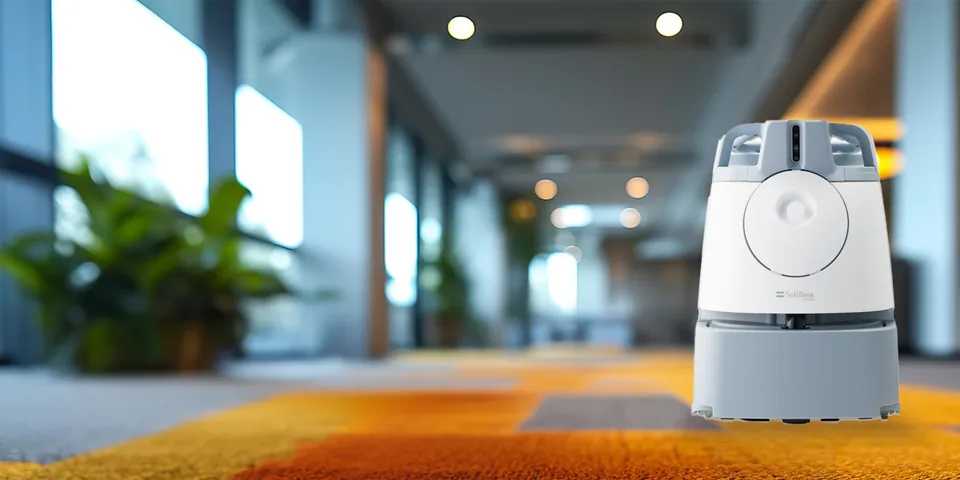
Here the differences are large. The Whiz runs on the BrainOS platform from Brain, and the maker states a cleaning rate of about 500 m² an hour and route learning by “teach and repeat”: the robot walks the planned path once and then repeats it, with no programming. The battery lasts about 3 hours. Dimensions and weight of the Whiz are not given, and the full datasheet is not public on the manufacturer's site, so a one-to-one comparison is limited.
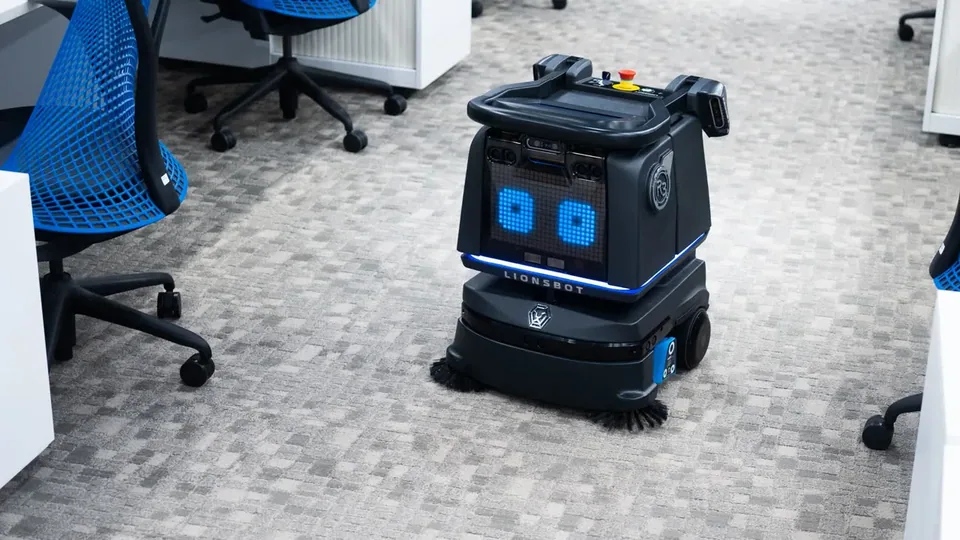
The R3 Vac has more complete data: 52.1 cm in height, dimensions of 482×655×521 mm, a weight of 53 kg, a 6-litre dust bin and navigation based on 3D LiDAR. The maker states about 1,260 m² an hour (13,563 square feet), 2–3 hours of runtime and a 2-hour charge. Both throughput figures are claimed by the makers, so they have to be confirmed on your own floor space. We explain how to read such figures in “How to Read a Robot Datasheet”.
Price and availability in Poland
The R3 Vac is clearly cheaper. According to RobotLAB it starts at USD 13,000 (about PLN 50,390 (≈ EUR 11,550) at the rate of 3.8762 on 1 October 2026), against USD 25,000 for the Whiz (about PLN 96,900 (≈ EUR 22,200)): USD 12,000 more, almost double. On RaaS the monthly rates are USD 369 and USD 1,042, so nearly three times as much for the Whiz. Set against the claimed throughput, that is about USD 10 per m²/h for the R3 Vac and about USD 50 for the Whiz.
Polish availability has not been confirmed for either robot. The Whiz is described by US sources, and LionsBot sells through RobotLAB and partners in Europe. Anyone importing should add duty, VAT and service, as discussed in “Humanoid Robot TCO: How to Calculate Total Cost”. Among market alternatives sold in Poland is the Pudu CC1, for which Polish shops list roughly PLN 73,000–75,000 (≈ EUR 16,730–17,190), or rental from about PLN 1,990 (≈ EUR 455) net a month.
Which model for which job
Both robots suit offices, shops and hotels (retail, hotels) with hard floors and carpets. The Whiz makes sense where a proven BrainOS platform and simple route teaching matter and the budget allows a higher subscription. The R3 Vac wins on a limited budget and large floor area: with a higher claimed coverage per hour, though its battery lasts at most as long as the Whiz's. For wet cleaning there is the sibling LionsBot R3 Scrub Pro, and for large halls the Gausium Scrubber 50 Pro. Cameras and LiDAR in public spaces also need to be assessed under GDPR (“Data Security: Robots with Cameras and the GDPR”); more on the segment in the category “Service robots”.
Conclusion
Whiz is the more expensive, at USD 25,000 to buy or USD 1,042 a month under RaaS (robot-as-a-service), versus USD 13,000 or USD 369 a month for the R3 Vac. With similar use (autonomous vacuuming of offices, shops and hotels), that makes the R3 Vac the cheaper subscription option in the long run. Whiz runs on Brain Corp's BrainOS platform, proven in many cleaning robots on the US market, while the R3 Vac relies on its own 3D LiDAR system with no external platform disclosed. Runtime is similar: 3 hours for Whiz versus 2.5 hours for the R3 Vac. Complete technical data from both manufacturers is not fully public; for Whiz in particular, the manufacturer's datasheet is explicitly not fully open. Both target similar segments: offices, retail and hospitality. The choice comes down mainly to the monthly RaaS cost, where the R3 Vac comes out ahead.
For most firms the R3 Vac is the more sensible choice: a purchase price almost half as high, a subscription nearly three times lower and a more complete specification. The Whiz is worth considering when you want the Brain Corp platform and simple route training, and the maker confirms the missing parameters in writing. An administrator starting with a pilot should take an R3 Vac subscription. Anyone buying for a chain of sites in Poland must first establish who will service the robot, because neither model guarantees it. The comparison rests on data from manufacturers and distributors, not on our own tests.
Frequently asked questions
Which robot is cheaper under RaaS?
The R3 Vac, at USD 369 a month, much less than USD 1,042 a month for Whiz.
What software platform does Whiz run on?
BrainOS, a system developed by Brain Corp and used in many cleaning robots on the US market.
Which model has the longer runtime?
Whiz, with 3 hours, slightly longer than the 2.5 hours declared for the R3 Vac.
Which robot is cheaper to buy and to subscribe to?
The R3 Vac: from USD 13,000 and USD 369 a month, against USD 25,000 and USD 1,042 a month for the Whiz.
What platform does the Whiz run on?
BrainOS from Brain Corp. It learns routes by “teach and repeat”, with no programming.
Which robot runs longer on the battery?
The Whiz: about 3 hours, against 2–3 hours stated for the R3 Vac, which charges in 2 hours.
Is either one officially available in Poland?
No Polish distributor has been confirmed for either the Whiz or the R3 Vac.
Sources
- SoftBank Robotics Whiz · robotlab.com
- SoftBank Robotics Whiz · us.softbankrobotics.com
- LionsBot R3 Vac · robotlab.com